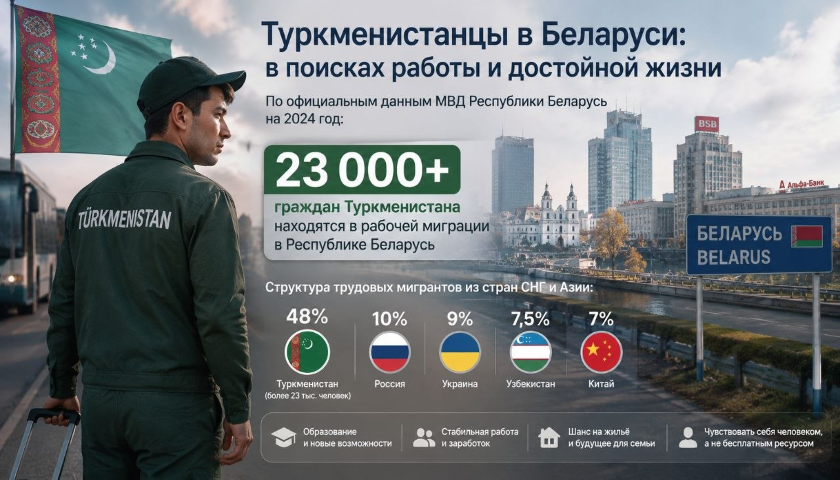
Why Turkmen Citizens Are Increasingly Moving to Belarus: Escaping Poverty, Forced Labor, and Hopelessness Belarus has become one of the countries to which Turkmen citizens are increasingly relocating — and this is no coincidence. For many Turkmen families, Belarus has long been viewed primarily as a country for education. Compared to Turkey or Azerbaijan, studying there is more affordable, student dormitories are available, the post-Soviet system feels familiar, and the mentality is culturally closer. Many young people go to Belarus as students, receive an education, build social connections, start families, and hope to eventually return home to build a normal life in their own country. However, after confronting the reality in Turkmenistan, many quickly realize that obtaining a decent job without personal connections, bribery, or influential contacts is nearly impossible. Even when people manage to find employment, they often face extremely low salaries, constant deductions, and degrading working conditions. Teachers, doctors, public sector employees, municipal workers, and even members of the security services are regularly forced to participate in cotton harvesting, agricultural labor, mass events, and official ceremonies welcoming state officials and the president. In many cases, all of this takes place outside regular working hours and without additional pay. If a person cannot participate, they are often required to pay for a replacement out of their own pocket. In addition, citizens are pressured into covering so-called “voluntary” expenses, including subscriptions to state newspapers and magazines, purchases of presidential portraits, and endless compulsory collections and contributions. In practice, it often feels as though every local official attempts to imitate the system of total control and behaves like a “small Berdimuhamedow” within their own institution. Many people are afraid to resign because losing even such a job means risking complete financial collapse. But eventually, countless citizens come to the conclusion that surviving without labor migration abroad has become impossible. Today, labor migration is no longer temporary or exceptional — for many families, it has become the only means of survival. Reports increasingly indicate that even military personnel are resigning in large numbers due to low salaries, lack of prospects, and harsh conditions. In an attempt to prevent a кадровый crisis, the authorities have already begun offering military service closer to soldiers’ places of residence. However, this appears more like an attempt to slow the consequences of a systemic crisis than a genuine solution. Against the backdrop of a demographic crisis and continuing mass migration, the long-term consequences for Turkmenistan may become catastrophic. Young people, professionals, skilled workers, and entire families are leaving the country. It is especially painful to realize that citizens of one of the world’s richest gas-producing nations are forced to search for work, housing, and basic stability abroad simply to live with dignity. At the same time, the International Labour Organization (ILO) is once again allocating approximately two million euros for a “decent work” project in Turkmenistan. There is strong hope that, at least this time, these funds will genuinely contribute to improving labor conditions rather than disappearing into polished reports and further enrichment of those connected to the system. The Human Rights Platform of the Civil Movement “Dayanç” has already submitted an official letter to the ILO describing the real situation, widespread labor rights violations, and proposals aimed at protecting the rights of Turkmen citizens, including labor migrants abroad. Perhaps the clearest indicator of the situation is that Belarus attracts Turkmen citizens not because of luxury or exceptionally high wages, but because it offers something far more basic: the opportunity to have housing, earn a living, and feel like a human being rather than a free resource for the system.
As a foundation, every individual's fundamental
protect and develop their rights
we are working for.