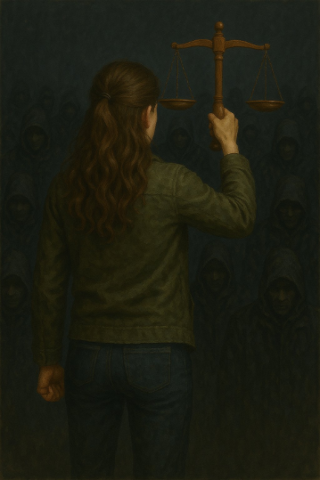
I often hear that activists and human rights defenders are “the fifth column,” “paid agents,” “traitors to the homeland,” and many other labels. And indeed, such perceptions exist mostly in the post-Soviet space and in the countries of Central Asia. But who are these people really? Why do they choose a path that rarely brings fame and is almost always filled with risk, loneliness, and pain? ?? Who Are Activists and Human Rights Defenders? An activist is someone who cannot stay silent in the face of injustice. A human rights defender is someone who takes on the responsibility of protecting others, even when left unprotected themselves. They don’t live “by the rules,” they don’t hide behind the phrase “it’s not my business,” and they don’t wait for someone else to solve the problem. These are the people who stand up first when everyone else stays quiet. They don’t get paid for fighting for freedom of speech, for women’s rights, for migrants, prisoners, or children. Their “payment” is threats, harassment, arrests, exile, fear for their loved ones… and sometimes, the silence of society. ?? The Emotions They Live With Every Day Every day, an activist lives on the edge — between hope and exhaustion. They wake up not thinking about themselves, but asking: “Who needs help today?” They may cry at night, but in the morning, they are back to writing letters, collecting signatures, and defending those who cannot defend themselves. It is a life without stability, but with a deep inner purpose. They feel fear — yet take a step forward. They feel pain — yet continue to speak the truth. They lose friends — but find faith in humanity. ?? The Dangers and the Price of Choice In countries where power fears the truth, activism becomes a crime. Where dictatorship calls itself “patriotism,” a human rights defender becomes a “traitor.” They face surveillance, threats, defamation, arrest, deportation, and even disappearance. Some are forced to flee their homeland, to live without documents, in exile. But even from afar, they continue to fight — not for glory, but for the memory of those left behind. ?? Why Such Labels Don’t Exist in Free Countries In democratic nations, activists are not enemies — they are the conscience of society. They serve on public councils, create foundations, reform laws, and help governments see their mistakes. Where there is freedom, the government does not fear criticism — because criticism helps it grow. But where the government fears its own people, it turns the truth into a crime. ?? What Drives Activists? Conscience. Not ideology, not money, not orders — but an inner sense of justice. When someone sees a person being humiliated, deceived, or oppressed — and cannot look away. It is a calling one cannot escape. Activists are not looking for enemies. They are searching for ways to create change, believing that truth and words can be stronger than fear and violence. ?? The One Trait They All Share The greatest trait is the courage to remain human, even when surrounded by fear. They are not saints or characters from books. They are ordinary people who simply lack an “off switch” for their conscience. That’s why they often seem inconvenient — because they remind others that silence is also a choice. ? In Conclusion Human rights defenders are the mirror of a society. If they are called “enemies of the people,” it means that society is afraid of the truth. If they are listened to — it means the society is ready for change. One day, these people will be remembered as heroes in history books. But today, they are the voices speaking in the darkness — so that someone else may awaken to the light. Diana Dadasheva
As a foundation, every individual's fundamental
protect and develop their rights
we are working for.