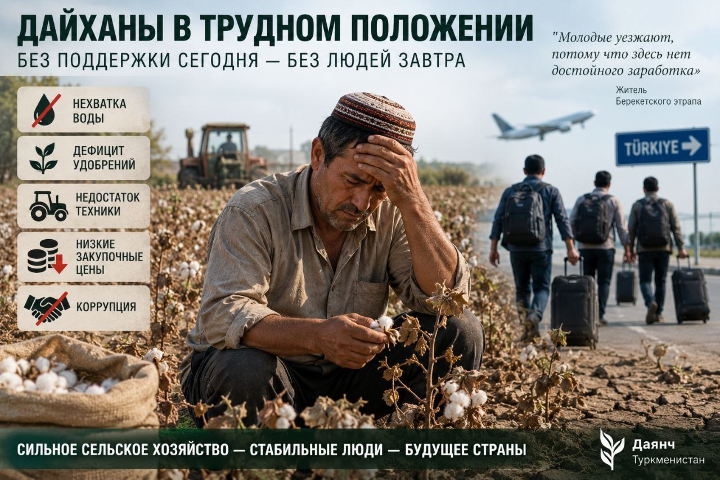
When Villages Empty: The Demographic Crisis as a Consequence of Turkmenistan’s Socio-Economic Policies Ahead of the next session of the Halk Maslahaty, the official agenda may once again be filled with statements about achievements, development and prosperity. Yet beyond the ceremonial halls lies a very different reality: people are leaving Turkmenistan, villages are losing their populations, working-age citizens are going abroad in search of employment, while accumulated socio-economic problems remain unacknowledged and unresolved for years. Recent testimonies from residents of rural areas published by Radio Azatlyk once again demonstrate the depth of the problem. Agriculture That Can No Longer Sustain Rural Families Farmers report shortages of water, fertilisers and agricultural machinery, high production costs, low state procurement prices and corruption at various stages of production and crop delivery. According to Azatlyk’s sources, a farmer may spend years growing cotton and fulfilling state production quotas while having virtually no opportunity to earn a decent income for their family. One comparison cited by a resident of Bereket district is particularly revealing: young people who have left to work on livestock farms in Türkiye can reportedly earn around USD 1,500 per month, while at home a person may work the land for years without achieving a comparable economic return. This is no longer merely an agricultural problem. When work can no longer provide a person with a decent standard of living, migration ceases to be a genuinely free choice and becomes a means of economic survival. Emptying Villages — an Alarming Demographic Warning Reports that rural communities are gradually becoming depopulated deserve particular attention. Young and working-age citizens are leaving the country in search of employment and stable incomes abroad. Along with them, Turkmenistan is losing workers, future entrepreneurs, specialists and the parents of the next generation. This creates a dangerous cycle: poverty → labour migration → loss of the working-age population → weakening of the regions → further economic deterioration → further migration. The consequences of this process cannot be measured solely by the number of people who have left the country. Large-scale and prolonged population outflow affects demographics, families, the labour market, agriculture and the future development of entire regions. Economic Problems Cannot Be Hidden Indefinitely Rising food prices, problems in agriculture, the gap between the official and unofficial exchange rates, low purchasing power and labour migration are not separate and unrelated phenomena. They are components of a single systemic crisis. Of particular concern is the fact that the Turkmen authorities do not engage in an open public discussion about the scale of migration and its underlying causes. Without accessible and reliable statistics, it is impossible to objectively assess the country’s population, the scale of labour migration and ongoing demographic changes. A problem does not disappear simply because the state refuses to acknowledge it publicly. The Halk Maslahaty Must Hear Those Who Are Leaving If the Halk Maslahaty genuinely represents the interests of the people, its sessions must address not only state programmes and official indicators, but also the issues that determine citizens’ everyday lives: Why do young people see no economic future for themselves inside the country? Why is agricultural work becoming economically unsustainable? Why are families being separated by years of labour migration? Why are villages becoming depopulated? Why are citizens forced to seek decent earnings outside their own country? And why does society not have access to complete and reliable statistics on population and migration? Population outflow is not merely a problem of those who have left. It is a problem of a state in which an increasing number of people see no realistic opportunity to live and work with dignity. The Human Rights Platform of the Civil Movement “Dayanch” / Turkmenistan considers it essential to openly acknowledge the scale of the country’s socio-economic and demographic problems and to begin addressing not merely their consequences, but their root causes. Turkmenistan does not need more declarations of prosperity. It needs conditions in which its citizens are not compelled to leave their own country simply to earn enough to provide a decent life for their families.
As a foundation, every individual's fundamental
protect and develop their rights
we are working for.