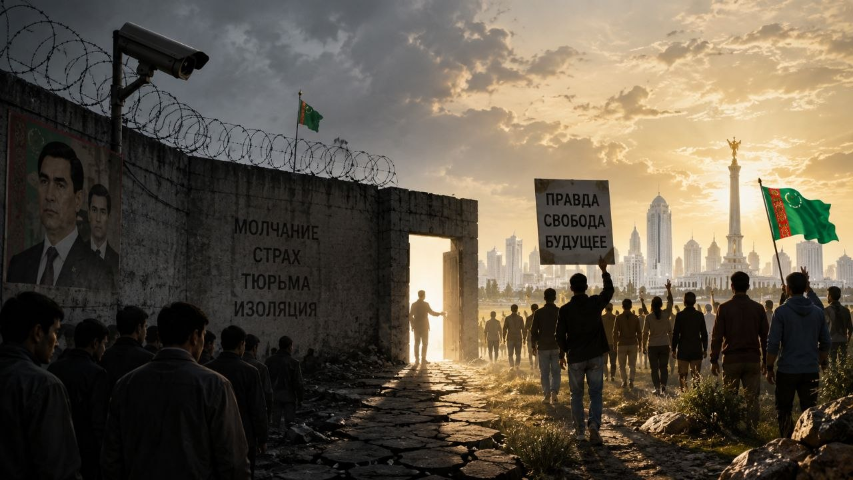
When the Opposition Is Erased from Public Memory: Why Turkmenistan Has Become the Most Closed Country in Central Asia According to an analytical report by Azattyq Asia (RFE/RL), opposition movements across Central Asia have steadily disappeared from public life over the past decades. Many opposition leaders have been imprisoned, forced into exile, or deprived of any opportunity to participate legally in the political process. While some countries in the region still retain limited elements of political competition, independent journalism, and civic activism, Turkmenistan stands apart as one of the most politically closed states in the world. In Turkmenistan, the authorities have systematically eliminated not only political opposition but even the very idea that opposition can legitimately exist. Today, there is virtually no independent civil society inside the country. Any criticism of the authorities can result in dismissal from employment, travel bans, arbitrary detention, criminal prosecution, or lengthy prison sentences. Fear has become one of the government's primary instruments of control, leaving most citizens unwilling to express their opinions out of concern not only for their own safety but also for the well-being of their family members. Particularly alarming is the situation facing the younger generation. An entire generation has grown up under the rule of the Berdimuhamedov family without ever witnessing genuine political competition, an independent opposition, or free and fair elections. For many young Turkmen, the very concept of political pluralism is unfamiliar. From early childhood, the state education system promotes a personality cult centered on the ruling family. Even in kindergartens, children participate in activities glorifying the current president and his predecessor. This ideological narrative continues throughout school, university, and public life. State propaganda has effectively replaced patriotism with unquestioning loyalty to the Berdimuhamedov family, portraying any form of dissent as a threat to the state. As a result, an entire generation has grown up without understanding that democracy depends on political pluralism, freedom of expression, and citizens' ability to choose among competing political alternatives. Meanwhile, a significant portion of Turkmenistan's opposition and civil society has been forced to continue its work in exile. However, operating abroad presents its own serious challenges. Opposition groups remain fragmented, face severe resource constraints, and continue to experience transnational repression. Turkmen activists have repeatedly reported threats, intimidation of their relatives, denial of consular services, abuse of international law enforcement mechanisms, and other forms of pressure aimed at silencing their work. The lack of unity among democratic forces abroad has also weakened their effectiveness. Although opposition organizations and civil society initiatives share the common goal of promoting democratic change in Turkmenistan, they often operate independently and without sufficient coordination. This makes it considerably more difficult to build a credible political alternative and develop a common strategy for democratic transformation. At the same time, experts interviewed by Azattyq Asia emphasize that the disappearance of formal opposition does not necessarily mean the disappearance of political dissent. Across Central Asia, civic activism has increasingly adapted to new realities by moving into social media, grassroots initiatives, independent journalism, and the work of organizations operating from abroad. In Turkmenistan, however, even these avenues remain among the most restricted in the world. The absence of independent political institutions, free media, and a vibrant civil society creates significant long-term risks for the country's future. When citizens are denied the opportunity to express grievances openly, debate public issues, and participate in decision-making, social tensions do not disappear—they accumulate beneath the surface. Experience from many countries demonstrates that the desire for freedom cannot be permanently suppressed. However, the longer a society lives under fear and total political control, the more difficult it becomes to rebuild public trust, democratic political culture, and independent institutions. For this reason, one of the most important challenges facing Turkmenistan's democratic movement today is not only to continue its human rights and civic advocacy work but also to overcome fragmentation. Greater unity among opposition groups, civil society organizations, independent journalists, and human rights defenders is essential to building a genuine democratic alternative and helping citizens understand that democracy is not a threat to the state, but rather a fundamental condition for its peaceful, stable, and just development. Source: Azattyq Asia (RFE/RL) — "Political Opposition in Central Asia: How It Disappeared and Whether It Can Re-emerge" https://www.azattyqasia.org/a/central-asia-opposition-kyrgyzstan-kazakhstan-uzbekistan-tajikistan-turkmenistan/33804748.html
As a foundation, every individual's fundamental
protect and develop their rights
we are working for.