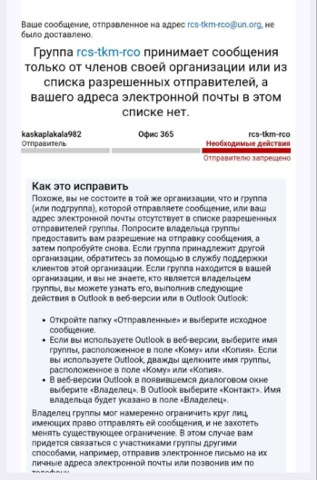
When the Doors Are Closed: Why Is It Impossible to Reach the United Nations in Turkmenistan? For nearly a year, the Dayanç Human Rights Platform / Turkmenistan has been trying to establish communication with United Nations agencies operating in Turkmenistan. We have sent numerous appeals to the UN Resident Coordinator's Office, UNDP, UNICEF, and other UN bodies regarding human rights violations, the protection of children, violence, the persecution of civil activists, and many other serious concerns. The result has been deeply disappointing. We have received virtually no substantive responses. In many cases, our emails were not even accepted for delivery. As the attached screenshot shows, we received an official non-delivery notification stating that the UN Resident Coordinator's Office email group accepts messages only from members of the organization or from pre-approved senders. All other emails are automatically rejected. This raises an obvious question: How are victims of human rights violations supposed to seek help? One might suggest using the official online contact form. Unfortunately, that option has proven ineffective as well. Based on our experience, the feedback mechanism either does not function properly or fails to provide any meaningful communication. We have also encouraged victims to submit their complaints in person. However, they encounter yet another barrier: the secretary refuses to accept the documents and verbally states that nothing can be done. Sadly, this approach is painfully familiar. It mirrors the practices of many state institutions in Turkmenistan, where citizens are routinely told: > "We cannot help you." It is especially alarming to witness this attitude from institutions whose mandate is to protect human rights and support the most vulnerable. During the same period, we have received responses from the European Union, the United States, diplomatic missions of various countries, and representatives of numerous international institutions. Many of them reviewed our submissions, replied, requested additional information, or continued constructive dialogue. Yet the UN agencies operating in Turkmenistan—including the UN Resident Coordinator's Office, UNDP, and UNICEF—have remained largely inaccessible to those attempting to report serious human rights violations. This raises important questions that deserve clear public answers. Why is it so difficult to communicate with international organizations whose mission is to protect people? Why are victims confronted with restricted email addresses, non-functioning communication channels, and refusals to accept their complaints? Why do official social media accounts regularly publish news about conferences, workshops, and training sessions, while the voices of real victims remain unheard? We believe that trust in international institutions is built not through social media posts, but through their willingness and ability to be accessible to those who genuinely need assistance. We therefore call on the United Nations Resident Coordinator's Office in Turkmenistan, UNDP, UNICEF, and all other UN agencies operating in the country to ensure that reliable and accessible communication channels are available, to receive complaints from citizens and civil society organizations, and to publicly explain how people in Turkmenistan can safely and effectively seek assistance. Source: Official Microsoft 365 non-delivery notification regarding an email sent to rcs-tkm-rco@un.org, provided by the Dayanç Human Rights Platform / Turkmenistan. The notification confirms that this address accepts messages only from members of the organization or from senders included on an approved list.
As a foundation, every individual's fundamental
protect and develop their rights
we are working for.