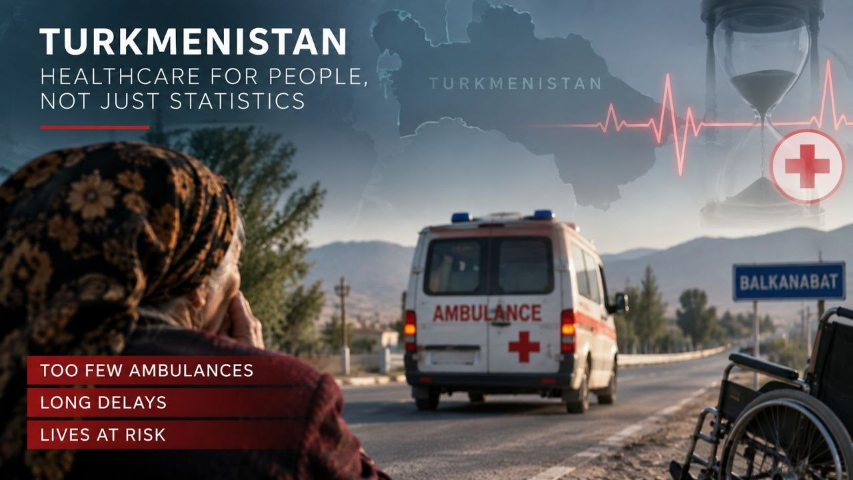
When Ambulances Do Not Arrive in Time: The Crisis of Access to Healthcare in Turkmenistan Must Be Raised at the Halk Maslahaty Human Rights Platform of the Dayanç Civil Movement / Turkmenistan 21 September 2026 The Human Rights Platform of the Dayanç Civil Movement has repeatedly raised concerns about access to healthcare in Turkmenistan, including shortages of ambulances and medicines and the effective inaccessibility of necessary treatment for a significant part of the population. A new report published by Radio Azatlyk’s Turkmen Service on 18 September 2026 once again illustrates how serious the consequences of this problem can be. According to sources cited by the outlet, there are not enough ambulances in Balkanabat and the surrounding districts, a significant part of the existing fleet is out of service, and patients are forced to wait for extended periods before receiving emergency medical assistance. According to Azatlyk, only a few ambulances in Balkanabat are operational, while dozens of vehicles require repairs. The report also recounts the case of a 60-year-old woman. According to a local source, the ambulance that had been called arrived approximately an hour and a half later. However, while transporting the woman to hospital, the vehicle broke down. A second ambulance then had to be called and awaited. According to Azatlyk’s source, the woman died. The situation appears to be even more serious in smaller communities and villages across Balkan Province. Residents report that in some districts, ambulances are expected to serve not only the district centre but also numerous surrounding settlements. As a result, distance, shortages of vehicles, their poor technical condition and insufficient fuel may directly affect how quickly people can receive emergency medical assistance. Azatlyk also reports, citing ambulance drivers, that the fuel allocated to emergency vehicles may be insufficient to cover an entire shift, forcing some drivers to purchase diesel fuel at their own expense. This is not simply a question of the condition of several vehicles. When a person suffering a heart attack, stroke, serious injury, severe bleeding or another medical emergency is forced to wait for hours for assistance, the issue becomes one of protecting human life and health. The Problem Goes Far Beyond Ambulances Dayanç has repeatedly raised concerns regarding access to healthcare in Turkmenistan. Of particular concern is the situation of persons with disabilities, pensioners, low-income families and people who require continuous medical treatment. The mere availability of a medicine in a pharmacy does not necessarily mean that it is genuinely accessible. If the cost of essential medicines is disproportionate to people’s actual incomes, if pensioners are forced to choose between purchasing medication and meeting their everyday needs, or if people with chronic illnesses cannot regularly afford prescribed medicines, access to healthcare is effectively restricted by economic circumstances. The discussion must therefore concern not only whether medicines are physically available, but also whether they are affordable. The situation in smaller towns and remote settlements must also be addressed. One or two ambulances cannot effectively cover vast territories and numerous communities at the same time. In emergency medicine, distance and response time can be critical. This Is a Human Rights Issue Article 12 of the International Covenant on Economic, Social and Cultural Rights recognizes the right of everyone to the enjoyment of the highest attainable standard of physical and mental health. For persons with disabilities, additional protections are provided under Article 25 of the Convention on the Rights of Persons with Disabilities, which recognizes their right to the enjoyment of the highest attainable standard of health without discrimination on the basis of disability. The real questions, therefore, should not be about showcase facilities or formal statistics, but about practical realities: Can a person call an ambulance and receive emergency assistance in time? Can a pensioner afford prescribed medication? Can a person with a disability obtain the treatment they need? Can someone living in a remote village expect the same protection of their life and health as someone living in a major city? An Issue Citizens Are Calling to Be Raised at the Halk Maslahaty In appeals and discussions involving citizens of Turkmenistan, healthcare remains one of the most pressing issues. Dayanç therefore considers it essential that the real accessibility of medical care be raised for public discussion in connection with the forthcoming Halk Maslahaty. Concrete answers and concrete measures are needed: Conduct a transparent assessment of the number of operational ambulances in every province and district. Provide sufficient numbers of emergency vehicles for smaller towns, villages and remote communities. Guarantee adequate funding for repairs, fuel and technical maintenance. Establish transparent ambulance response-time standards and publish data on compliance with those standards. Ensure adequate numbers of healthcare professionals and decent working conditions for medical personnel. Review mechanisms for providing affordable medicines to pensioners, persons with disabilities, low-income families and patients with chronic illnesses. Take measures to ensure that the prices of essential medicines are compatible with the actual economic circumstances and incomes of the population. Establish an accessible complaints mechanism for cases involving refusal, delay or inadequate provision of medical assistance, and ensure independent consideration of such complaints. The construction of modern buildings cannot, by itself, serve as evidence of accessible healthcare. A healthcare system should be assessed first and foremost by whether ordinary people receive the medical assistance they need when they actually need it. No person should die because an ambulance is too far away, because the vehicle is out of service, because there is insufficient fuel, or because essential medicine is beyond their financial means. The right to health must not depend on where a person lives, their age, disability, or income. Human Rights Platform of the Dayanç Civil Movement / Turkmenistan Source: Radio Azatlyk, Turkmen Service, 18 September 2026 https://www.azathabar.com/a/balkanabatda-we-etraplarda-tiz-komek-ulaglary-sandan-cykyp-hassalar-komeksiz-galyar/33858796.html
As a foundation, every individual's fundamental
protect and develop their rights
we are working for.