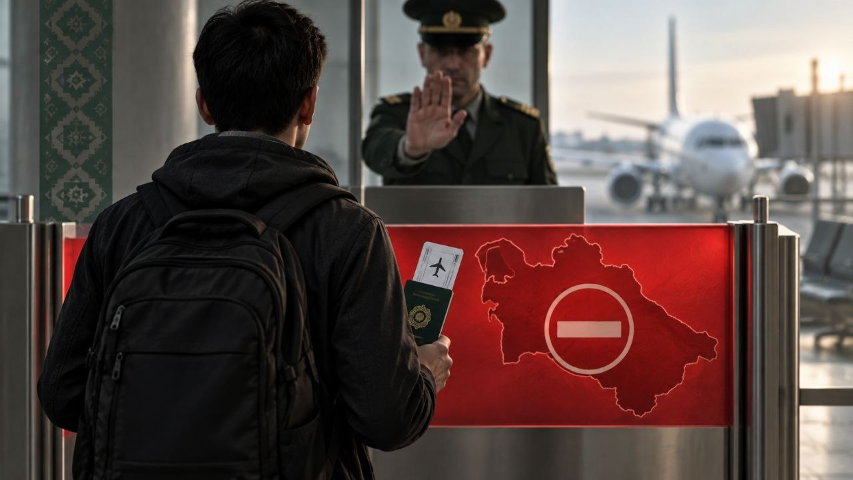
Turkmenistan Turns Its Borders into an Instrument of Punishment: Exit Bans Remain One of the Country’s Most Pressing Human Rights Problems Freedom of movement in Turkmenistan increasingly exists only on paper. Citizens arrive at airports with valid passports and tickets, with no criminal convictions and no record of breaking the law, only to discover at passport control that they are prohibited from leaving the country. According to Radio Azatlyk, the issue of difficulties and restrictions on leaving Turkmenistan currently ranks first among the topics attracting the greatest interest from citizens of Turkmenistan. This is significant: the problem no longer affects only activists or government critics, but also students, former military personnel, public-sector employees, and ordinary citizens. In a report published by Radio Azatlyk on 7 September 2026, several young people described how they had studied abroad, returned to Turkmenistan, and then unexpectedly discovered that their names had been placed on so-called “exit-ban lists.” One resident of Lebap Province said that on 30 August he intended to fly from Ashgabat to Türkiye but was stopped at passport control. Only at the airport was he informed that he had been included among those prohibited from leaving the country. He had received no prior official notification. Another young man, who also intended to continue his education in Türkiye, said airport officials told him: “A deport has been placed on you; return to your province.” Yet this was not a case of deportation from a foreign country. In practice, it amounted to preventing a Turkmen citizen from leaving his own country. Particularly alarming is information cited by Radio Azatlyk sources indicating that former students of foreign universities who had either been expelled or discontinued their studies voluntarily were being placed on lists imposing a one-year prohibition on leaving the country. In many cases, citizens are reportedly not told which authority issued the decision, under which legal provision it was made, when it entered into force, or how it can be appealed. Restrictions have also reportedly affected another category of citizens — former military personnel — who have faced obstacles to travelling abroad even after being officially discharged from the Armed Forces and despite having no access to state secrets. What is emerging is a deeply troubling system in which a person’s right to leave the country depends not on a transparent law or judicial decision, but on an opaque administrative list. This Is a Matter of International Law Such practices directly engage Turkmenistan’s international human rights obligations. First and foremost, Article 12 of the International Covenant on Civil and Political Rights (ICCPR), to which Turkmenistan is a State Party, provides: > “Everyone shall be free to leave any country, including his own.” Article 12(3) permits restrictions only in exceptional circumstances. Such restrictions must be provided by law, genuinely necessary to protect national security, public order, public health or morals, or the rights and freedoms of others, and consistent with the other rights recognised in the Covenant. A state therefore cannot simply place a person on a secret list and deprive them of the ability to leave the country on an indefinite, arbitrary, or unexplained basis. The UN Human Rights Committee’s General Comment No. 27 further clarifies that restrictions on freedom of movement must not become the rule. They must comply with the principles of legality, necessity, and proportionality. Individuals must be able to understand the reasons for state interference and must have access to effective remedies. The practice described by Radio Azatlyk is also incompatible with Article 13 of the Universal Declaration of Human Rights, which states: > “Everyone has the right to leave any country, including his own, and to return to his country.” Where an exit ban prevents young people from continuing their education abroad without an objective and lawful justification, it may also interfere with the right to education, protected under Article 13 of the International Covenant on Economic, Social and Cultural Rights (ICESCR). This is therefore not merely an inconvenience at the border. Where restrictions are imposed without transparent legal grounds, an individually reasoned decision, prior notification, or an effective mechanism of appeal, the system takes on the characteristics of an arbitrary restriction of a fundamental human right. The Border as a Means of Controlling Society The most dangerous aspect of this practice is its unpredictability. A person buys a ticket. Pays tuition fees. Receives an admission letter from a foreign university. Makes plans for employment or family reunification. Arrives at the airport — and only then discovers that the state has decided not to allow them to leave. No court decision. No official document. No clearly stated deadline. No understandable appeal procedure. The citizen is forced to determine for themselves who deprived them of a fundamental right and why. This is not how a rule-of-law system should operate. If the state considers an exit restriction genuinely necessary, it must identify the specific legal provision, provide the concrete grounds for the restriction, specify its duration, notify the individual concerned, and provide access to an independent appeal procedure. Otherwise, so-called “blacklists” become a mechanism of administrative pressure. The situation of students is particularly disturbing. A young person may first be restricted by systems of government approval and official lists of recognised foreign universities; later, after being forced to change or discontinue their studies and return home, the state effectively punishes them again by preventing them from leaving the country. This is no longer simply migration policy. It is a system of control over an individual’s life. The fact that, according to Radio Azatlyk, the issue of exit bans ranks first among topics attracting public interest demonstrates the scale of concern within Turkmen society. For thousands of citizens, the question is now extremely simple: Why does the state believe it has the right to decide whether a person may leave their own country without explaining the reason, the legal basis, or the means available to defend their rights? Turkmenistan must end the practice of opaque “blacklists,” disclose the legal grounds for existing restrictions, formally notify every affected citizen, and guarantee a genuine and independent mechanism for challenging such decisions. The right to leave one’s own country is not a privilege granted at the discretion of the state. It is a fundamental human right protected by international law.
As a foundation, every individual's fundamental
protect and develop their rights
we are working for.