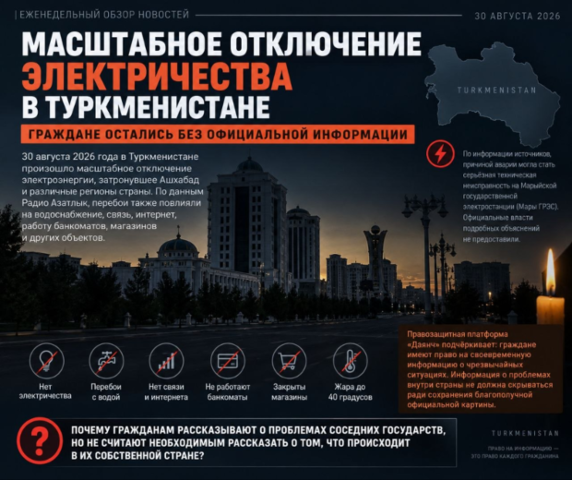
Turkmenistan Plunged into Darkness: Why Are Citizens Told About Power Outages in Neighbouring Countries but Not About Their Own? On 30 August 2026, Turkmenistan experienced a large-scale power outage. According to Radio Azatlyk, at approximately 5:20 p.m., electricity went out simultaneously in Ashgabat and several regions of the country. In some areas, the power supply remained unavailable for several hours and was restored only gradually. The consequences went far beyond an ordinary household inconvenience. Along with electricity, there were disruptions to water supplies, internet and telephone services, while ATMs and electronic payment systems stopped working. Shops, pharmacies and service businesses were also affected. With temperatures reaching around 40°C, people were left without air conditioning and lifts. There were also reports of difficulties reaching certain emergency services by telephone. In Lebap Region, residents and business owners told Azatlyk about thefts that occurred during the blackout. An increased police presence was also reported on the streets. What Happened at the Mary State Power Plant? Sources cited by Azatlyk linked the large-scale outage to a serious technical failure at the Mary State Power Plant. The Turkmen authorities provided no public explanation of the cause of the incident. The following day, reports emerged that security measures at the power plant had been tightened. According to Azatlyk, citing plant employees, workers’ mobile phones were being checked and confiscated, while surveillance was reportedly increased amid concerns that photographs and videos of the incident might be leaked. If these reports are accurate, a fundamental question arises: why does controlling information appear to become a priority after such an incident instead of openly informing the public about what happened and what measures are being taken? The scale of the disruption was also reflected beyond Turkmenistan’s borders. Afghanistan’s electricity company, Da Afghanistan Breshna Sherkat, reported interruptions to electricity supplies imported from Turkmenistan. On 31 August, the company announced that electricity had been restored in Badghis and Andkhoy and that work was under way to reconnect other affected areas. It Is Acceptable to Report on Neighbours — but Not on Turkmenistan? The contrast in the way information is presented is particularly striking. Earlier, pro-government Turkmen bloggers had actively reported on a power outage that affected several Central Asian countries on 14 August. Citizens of Turkmenistan were told about electricity problems in Kazakhstan, Kyrgyzstan, Tajikistan and Uzbekistan. Yet when a major power outage occurred in Turkmenistan itself, the same level of openness was nowhere to be seen. Why? Why can citizens of Turkmenistan learn from state-aligned and pro-government information sources about electricity problems in a neighbouring country, yet receive no comprehensive information about a major disruption in their own country? Do citizens of Turkmenistan not have the right to know why electricity, water and communications suddenly disappeared from their homes? This is not about the image or reputation of the state. It is about public safety. During a major infrastructure failure, the authorities have a responsibility to inform the population promptly about what has happened, which areas are affected, how long restoration is expected to take, where people can seek assistance, and whether hospitals, water supplies, communications or other critical infrastructure are at risk. Electricity Exports While Citizens Face Outages at Home The situation raises another legitimate question. Turkmenistan exports electricity to other countries, including Afghanistan, while citizens inside Turkmenistan have for years reported recurring disruptions to their own electricity supply. Electricity exports may be an important part of the country’s economy. But they do not relieve the state of its responsibility to maintain reliable infrastructure and ensure the safety of its own population. The large-scale outage of 30 August should therefore lead not to the suppression of information, but to a transparent technical investigation. Citizens have the right to receive answers: What exactly happened at the Mary State Power Plant? Why did the failure affect such a large part of the country? Were backup power systems prepared for an incident of this scale? What measures have been taken to prevent a recurrence? Why did the population receive no timely official warning or explanation? And the most important question goes far beyond a single power plant: Why are citizens of Turkmenistan readily informed about problems in neighbouring countries, while an information blackout follows when the problem occurs at home? The right to information is especially important when the safety of millions of people is at stake. A state should not leave its citizens in the dark — either literally or informationally. Source: Radio Azatlyk, reports published on 30 August and 1 September 2026.
As a foundation, every individual's fundamental
protect and develop their rights
we are working for.