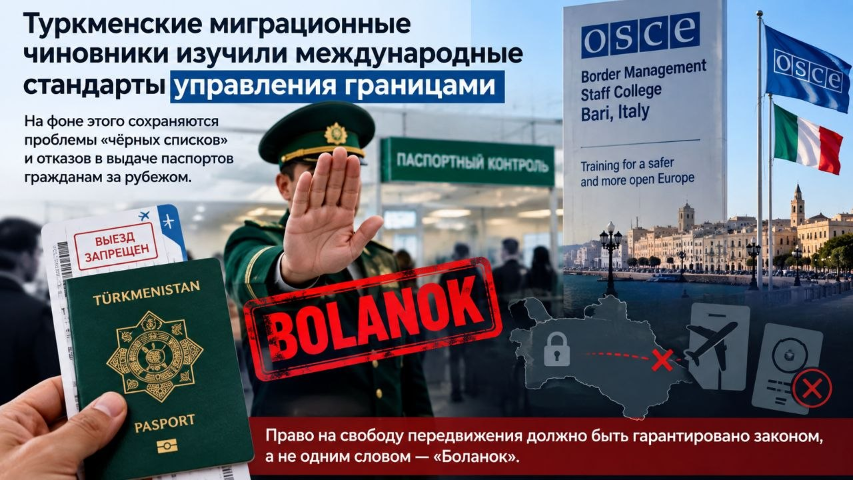
Turkmenistan Learns Border Management: “Bolanok” as a National Practice? Representatives of the State Migration Service of Turkmenistan took part in the 42nd Border Management Staff Course organized by the OSCE Border Management Staff College (BMSC) in Bari, Italy. According to the report, participants studied international standards for integrated border management, strategic planning, risk assessment, crisis management, and modern migration control practices. International training is certainly useful. But in Turkmenistan’s case, an obvious question arises: when will these international standards be fully applied to the country’s own citizens? Independent media and human rights defenders have for years reported on so-called “blacklists” of citizens barred from leaving the country. A person with a valid passport, visa, and ticket may arrive at the airport only to discover at the border that they are prohibited from leaving. Under what law? Which article? Who made the decision? For how long? Where is the written legal justification? How and where can the decision be appealed? Instead of answers, a person may effectively be met with one short response: “Bolanok.” And that is it. An entire model of border management can almost be summed up in this single word: “bolanok” — and as for why, on what legal grounds, and for how long, try finding out for yourself. There is another side to this system. Turkmen citizens living abroad have for years faced problems obtaining new passports through the country’s diplomatic and consular missions. Administrative extensions of existing passports do not replace a proper system that enables citizens abroad to obtain new documents. The result is a rather peculiar situation: inside the country — “bolanok, you cannot leave”; outside the country — problems obtaining a new passport. Meanwhile, state representatives are studying Europe’s “best international practices” in migration and border management. The reaction of readers to the news was particularly telling. One user wrote: > “I think the Turkmen representatives were sharing their experience of how not to let foreigners into the country. Turkmenistan’s experience is invaluable against the backdrop of Europe’s migrant crisis.” Another commenter continued sarcastically: > “They were teaching the Italians how to extort money and beg passengers for food.” And another reader simply asked: > “But how are people supposed to live?” These comments, of course, reflect the personal opinions of individual readers and should not be treated as established facts. However, the irony surrounding such news is understandable in the context of long-standing reports concerning restrictions on the freedom of movement of Turkmen citizens. Article 12 of the International Covenant on Civil and Political Rights guarantees everyone the right to leave any country, including their own. Restrictions on this right must have a lawful basis and comply with applicable international requirements. What we would therefore like to see as a practical outcome of such international training is transparent legal grounds for travel restrictions, written and reasoned decisions, an effective right of appeal, an end to opaque “blacklist” practices, and a functioning system for issuing new passports to Turkmen citizens through diplomatic missions abroad. Because modern border management should be based first and foremost on law, clear procedures, and respect for human rights. And “bolanok” is not an article of law.
As a foundation, every individual's fundamental
protect and develop their rights
we are working for.