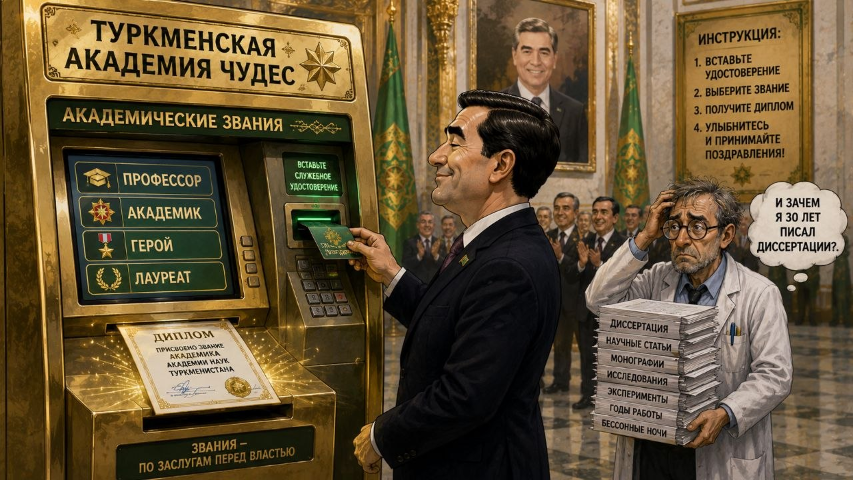
Turkmen Academy of Miracles When reality can no longer keep up with imagination. On June 11, Turkmenistan once again demonstrated that miracles do exist. According to official reports, President Serdar Berdimuhamedov was awarded the academic title of Professor in Economic and Political Sciences and was also elected as an Academician of the Academy of Sciences of Turkmenistan. The announcement was made with such confidence and ceremony that many scholars around the world may now be wondering whether they wasted decades conducting research, publishing scientific papers, teaching students, and defending dissertations. Apparently, there is a much faster route. There was a time when academic titles represented the highest recognition of a lifetime devoted to science. Researchers spent years in laboratories, archives, and libraries. They conducted studies, participated in scholarly debates, published their findings, and contributed new knowledge to humanity. Today, some countries seem to have developed a more innovative approach. Why spend decades building an academic career when one can move directly to the final result? According to the official statement, the achievements of the newly appointed professor and academician are so extraordinary that they encompass nearly every sphere imaginable: economics, politics, science, industry, innovation, international cooperation, and even the pursuit of a peaceful foreign policy. One can only wonder why the list was not expanded to include astrophysics, medicine, archaeology, and space exploration. Perhaps those honors are still to come. At the current pace, future announcements may look something like this: Professor of Medicine for wishing citizens good health; Academician of Space Sciences for observing the stars during official ceremonies; Distinguished Agricultural Scientist for appearing at harvest events; Honored Engineer for inaugurating monuments; Recipient of a Literary Prize for reading his own books. The irony would be amusing if it were not part of a broader and more troubling reality. Behind such ceremonies stand countless genuine scholars, teachers, researchers, and students whose work rarely receives recognition. Many dedicate their lives to education and scientific inquiry while facing restrictions on academic freedom, limited resources, and a lack of independent research institutions. Science advances through critical thinking. Academic excellence depends on independence. Knowledge grows through open discussion, debate, and evidence. When academic titles become associated primarily with political office rather than scholarly achievement, an unavoidable question arises: What value will these titles hold in the future? History offers many examples of governments attempting to place political authority above science, education, and intellectual merit. The outcome is usually the same. Scientific discoveries endure. Political titles rarely do. Ten or twenty years from now, few people may remember another ceremonial decision by another committee. But history is far more likely to remember the scientists, educators, and researchers who genuinely expanded human knowledge, even if they never received grand titles from official institutions. For now, however, one can only congratulate the Turkmen Academy of Miracles on once again demonstrating that, in some places, academic honors are awarded not for scientific achievements, but for the remarkable ability to transform political power into a source of every possible distinction. It appears that, at this academy, miracles have become a routine administrative procedure.
As a foundation, every individual's fundamental
protect and develop their rights
we are working for.