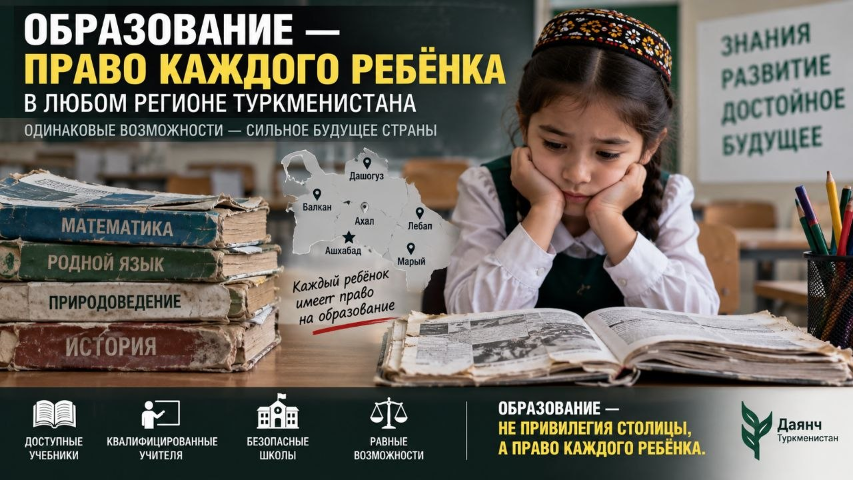
The Right to Education Must Not Depend on Where a Child Lives Every child in Turkmenistan — whether in Ashgabat, a regional centre, or the most remote village — has an equal right to accessible, quality education. The state must guarantee this right not merely on paper, but in practice. The beginning of the new school year has once again exposed problems that can hardly be described as isolated incidents. According to Azatlyk Radiosy, parents at a number of schools in the Ahal and Mary regions were given severely worn-out textbooks, some with damaged pages, writing and other defects. Some parents refused to accept them, fearing that at the end of the school year they themselves could be required to pay compensation for the damage. There have also been reports of parents being required to pay for old or damaged textbooks. At the same time, according to the outlet’s sources, some usable books may have been distributed to people other than the pupils for whom they were intended. This raises a simple question: why should parents have to struggle to obtain a proper textbook for their child? A Textbook Is Not a Privilege — It Is Part of the Right to Education The constitutional right to education loses its meaning if children are not provided with the basic conditions necessary for learning. There can be no genuine equality of opportunity when a pupil in one school receives the necessary educational materials while a child in another is forced to use a textbook with missing or damaged pages. It is even more unacceptable to shift responsibility for chronic textbook shortages onto families. This problem is particularly serious in the regions. A child’s place of birth or residence must not determine the quality of their education. Children in Ashgabat, Mary, Dashoguz, Lebap, Balkan and Ahal — whether they live in a regional centre or a small village — must have equal access to textbooks, qualified teachers, safe schools, modern educational materials and technologies. The State Must Be Accountable for Results, Not Reports Against the backdrop of official reports about the publication of new textbooks, years of complaints about shortages and the poor condition of schoolbooks require a public explanation. How many textbooks do the country’s schools actually need? How many have been printed? How are they distributed among the regions? Why, at the beginning of another school year, are some families once again reporting a shortage of usable textbooks? The public has a right to clear answers to these questions. If the state declares education to be free, families should not have to compensate for deficiencies in the public education system out of their own pockets, purchase materials that schools are required to provide, or fear financial claims for textbooks that were already worn out when they received them. It is particularly alarming that parents reporting such problems feel compelled to remain anonymous because of concerns for their safety. A parent raising concerns about their own child’s education must not become a risk to the family. The Human Rights Platform of the Civil Movement “Dayanch” / Turkmenistan calls for transparent oversight of the provision of textbooks to schools, an investigation into reports of improper distribution of educational materials, and the establishment of a safe mechanism through which parents can submit complaints and concerns. A child’s right to education begins with very basic things: a school, a teacher and a textbook. The state has an obligation to guarantee them to every child — regardless of region, family income or place of residence. Education is not a privilege of the capital. It is the right of every child in Turkmenistan.
As a foundation, every individual's fundamental
protect and develop their rights
we are working for.