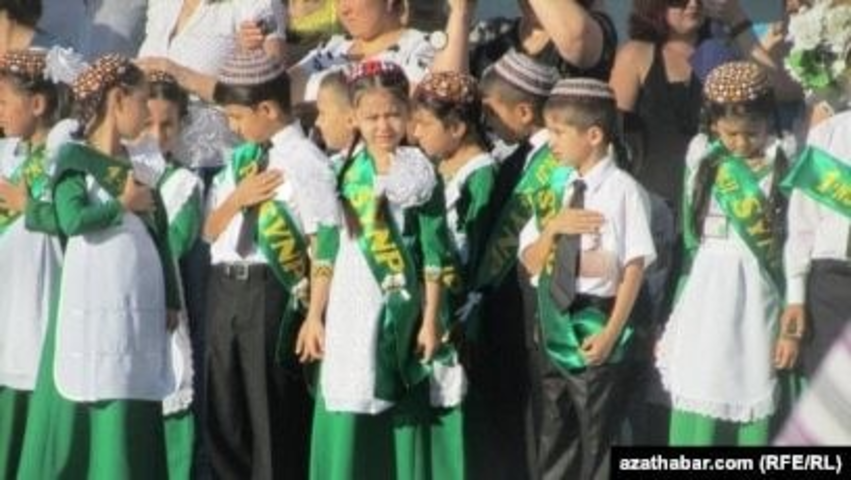
The Price of “Free” Education: What Is Happening to Turkmenistan’s Schools The new academic year in Turkmenistan is beginning amid reports that point not to isolated shortcomings, but to systemic problems in the country’s education system. The number of first-grade pupils is declining, teachers’ workloads and incomes are being reduced, parents are facing ever-increasing school-related expenses, reports of informal payments and corruption continue to emerge, and children are still being required to participate in hours-long state-organized events, sometimes, according to sources, at the expense of their health. Behind the festive image of September 1, a very different reality is becoming increasingly visible. Fewer Children Are Entering School According to information published by Azatlyk Radiosy on September 1, 2026, citing sources in the education sector, the number of children entering first grade has fallen significantly. In Mary Province, more than 38,000 children entered first grade in 2020, compared with approximately 27,000 in 2026. This represents a decline of more than 11,000 children, or approximately 29%. In Lebap Province, the number fell from more than 31,000 first-graders in 2020 to 20,987 this year — a decline of approximately 32.3%. Sources cited by Azatlyk claim that in some remote communities the decline has reached 50–60%. These figures can no longer be viewed merely as education statistics. They require a transparent public explanation addressing possible factors such as demographic trends, large-scale labor migration, the socio-economic situation of families, and population outflow. Teachers are also directly affected. According to the reports, declining student numbers are leading to the consolidation of classes, while teaching positions in some areas are being reduced from full-time to 0.75 or even 0.5 of a full-time position. This inevitably results in a corresponding reduction in teachers’ incomes. How Much Does “Free” Schooling Really Cost? Another serious issue is the financial burden placed on parents. Education is formally free. In practice, however, the beginning of every academic year requires families to purchase school uniforms, sportswear, shoes, backpacks, notebooks, stationery, and numerous other essential items. And the expenses do not end there. The Dayanç Human Rights Platform / Turkmenistan previously published a dedicated video examining the cost of preparing children for school. The public response was as important as the video itself: in the comments, citizens described their actual expenses, the difficulty of purchasing everything required on existing household incomes, and the particularly severe burden faced by families who have to prepare several children for school at the same time. Azatlyk has also reported that parents continue to be asked to contribute money for school and sports clothing, stationery, and various school supplies. This raises a simple question: How much does state-guaranteed “free education” actually cost an ordinary Turkmen family? If the state guarantees free education, parents should not become a hidden source of financing for schools. Corruption Reaches the Classroom Particularly concerning are reports published by Turkmen.news regarding the situation at School No. 55 in Ashgabat. According to the outlet, parents and teachers have reported money collections, repairs financed by parents or teachers, outdated equipment, and possible corrupt practices. It has also been alleged that funds for upgrading computer classrooms and equipment were allocated as early as October 2025, while pupils reportedly continue to use computers purchased around two decades ago. There are also reports that certain school improvements have effectively been financed by parents. Even more serious are allegations concerning the treatment of children. Sources cited by the outlet claim that some teachers shout at pupils, confiscate and inspect their phones, and may use physical punishment. These are extremely serious allegations that require neither silence nor administrative cover-up, but an independent investigation with effective safeguards for children, parents, and teachers who are willing to provide testimony. Six-Year-Old Children Under the Sun for a Television Image An Azatlyk report dated August 31 raises an even more fundamental question: where does education end and the exploitation of children for state propaganda begin? According to sources cited by the outlet, six-year-old children preparing to enter first grade in Ashgabat were required to participate in rehearsals connected with the beginning of the academic year and state television filming. Children were reportedly made to stand and rehearse under the sun for hours. Some became unwell, and cases of children losing consciousness were reported. Particularly alarming are claims that children who became ill were not always immediately allowed to go home. According to sources, teachers sometimes had to call medical personnel, after which children could be returned to the event. If these reports are accurate, this is no longer a matter of school discipline or preparation for a ceremonial event. The health of a six-year-old child cannot be sacrificed for a polished television image. No president, minister, school director, or state television broadcaster can have an interest that takes precedence over a child’s health, dignity, and well-being. Education Cannot Be Built on Fear and Coercion These reports must be considered together. Parents are finding it increasingly difficult to afford the cost of preparing their children for school. Teachers are facing reductions in their workloads and incomes. Student numbers are falling sharply. Reports of informal payments and corruption persist. Individual schools face allegations of humiliating or physically abusive treatment of children. At the same time, pupils continue to be used in lengthy mass events primarily intended to create an official television image. The problem therefore extends far beyond one school, one principal, or one academic year. The fundamental question is what place a child occupies within the state system: is the child recognized as a human being with rights and dignity, or treated as a convenient participant in official events and an object of administrative control? The Dayanç Human Rights Platform / Turkmenistan calls for an independent investigation into reports of informal payments and corruption in schools, full transparency regarding public funding for educational institutions, the establishment of safe complaint mechanisms for parents, children, and teachers, an end to all forms of physical and psychological violence, and the elimination of any compulsory participation of minors in prolonged state-organized events. The sharp decline in student numbers and the deteriorating situation of teachers also require a clear and public response from the authorities. A school must be a place where a child learns, develops, and is safe. It must not become a place where parents are forced to pay, teachers fear losing their livelihoods, children stand under the sun for hours, and serious problems disappear behind a carefully staged television image. Dayanç Human Rights Platform / Turkmenistan September 2, 2026
As a foundation, every individual's fundamental
protect and develop their rights
we are working for.