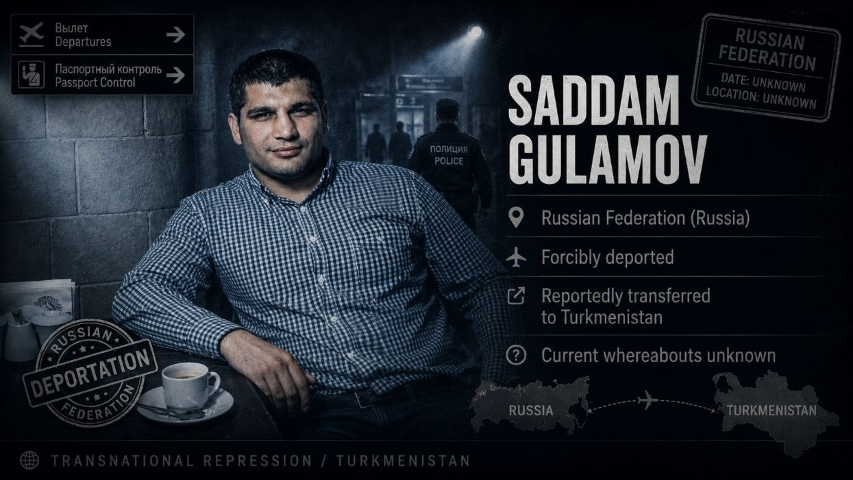
The Price of Criticizing Dictatorship: Saddam Gulamov Sentenced to Five Years in Prison Turkmen civil activist Saddam Gulamov, who was extradited from the Russian Federation at the request of the authorities of Turkmenistan, has been sentenced to five years of imprisonment. This became known through documents published by the Prosecutor General’s Office of the Russian Federation, as well as materials reviewed by the independent media outlet Turkmen.news. According to the published information, Russia approved Turkmenistan’s extradition request on December 20, 2023. Saddam Gulamov was transferred to the Turkmen authorities on March 1, 2024. On May 13, 2024, the Ashgabat City Court issued a guilty verdict and sentenced him to five years in prison. The publicly available documents do not disclose the specific charges or the exact criminal offense for which Gulamov was convicted. The only confirmed information is that he received a five-year prison sentence. According to independent sources, during 2020–2021 Saddam Gulamov openly criticized the authorities of Turkmenistan. He raised concerns about the country’s economic and food crises, criticized the government's denial of the COVID-19 pandemic, and drew attention to the consequences of a devastating hurricane that state-controlled media largely ignored. He also encouraged citizens not to fear expressing their opinions and to speak openly about the problems facing the country. Human rights defenders have repeatedly emphasized that such cases raise serious concerns regarding the right to freedom of expression, a right guaranteed under Turkmenistan’s international obligations, including the International Covenant on Civil and Political Rights. The case of Saddam Gulamov serves as yet another alarming reminder that transnational repression targeting Turkmen civil activists, bloggers, journalists, and human rights defenders continues and has become systemic in nature. Increasingly, criticism of the authorities, human rights work, participation in public life, and the peaceful expression of opinions are being used as grounds for persecution, detention, extradition, deportation, and criminal prosecution of Turkmen citizens beyond the country’s borders. Particularly alarming is the fate of Turkmen civil activists Alisher Sakhatov and Abdulla Orusov, who disappeared after being released from the deportation center in Edirne, Türkiye. Despite numerous appeals from relatives, lawyers, human rights organizations, and international institutions, there is still no reliable information regarding their whereabouts or fate. Their disappearance remains one of the most troubling cases involving the safety of Turkmen activists abroad. Equally concerning is the case of Maral Annayeva, a Turkmen citizen who, together with her two children, was deported from the United Arab Emirates. Maral Annayeva is known as a survivor of domestic violence and as a woman who sought protection and safety for herself and her children. According to available information, representatives of the Turkmen Consulate in Dubai initially accused her of engaging in prostitution. After her lawyer demanded the withdrawal of those allegations and warned of possible legal action for defamation, those accusations were no longer pursued. Subsequently, another mechanism was allegedly used against her: she was detained through an Interpol-related process initiated at the request of the Turkmen authorities and was later deported to Turkmenistan together with her two children. This case has raised serious concerns among human rights defenders and has become another example of the vulnerability of Turkmen citizens to transnational forms of persecution. According to the Human Rights Platform of the Civic Movement “Dayanch” / Turkmenistan, at least 14 citizens of Turkmenistan have become victims of transnational repression in recent years. Among them are civil activists, bloggers, journalists, human rights defenders, and members of their families. They have faced detention, deportation, extradition, criminal prosecution, misuse of international search mechanisms, threats, intimidation, pressure on relatives, and enforced disappearances. These cases demonstrate the urgent need for greater international attention to the problem of transnational repression, which poses a serious threat not only to individual activists but also to fundamental human rights. Freedom of expression, participation in public life, personal security, and protection from arbitrary persecution should never depend on a person’s political views. The Human Rights Platform of the Civic Movement “Dayanch” / Turkmenistan calls on the United Nations, the OSCE, the European Union, democratic governments, international human rights organizations, and independent monitoring mechanisms to continue closely monitoring the cases of Saddam Gulamov, Alisher Sakhatov, Abdulla Orusov, Maral Annayeva, and other citizens of Turkmenistan who have become victims of transnational repression. We also call for effective, independent, and transparent investigations into all cases of enforced disappearances, politically motivated persecution, deportations, and extraditions involving citizens of Turkmenistan. Freedom of expression is not a crime. Criticism of those in power should not lead to imprisonment. No enforced disappearance should remain without investigation, and no victim of transnational repression should be left without protection and justice. Source of information: Turkmen.news Source of documents: Prosecutor General’s Office of the Russian Federation
As a foundation, every individual's fundamental
protect and develop their rights
we are working for.