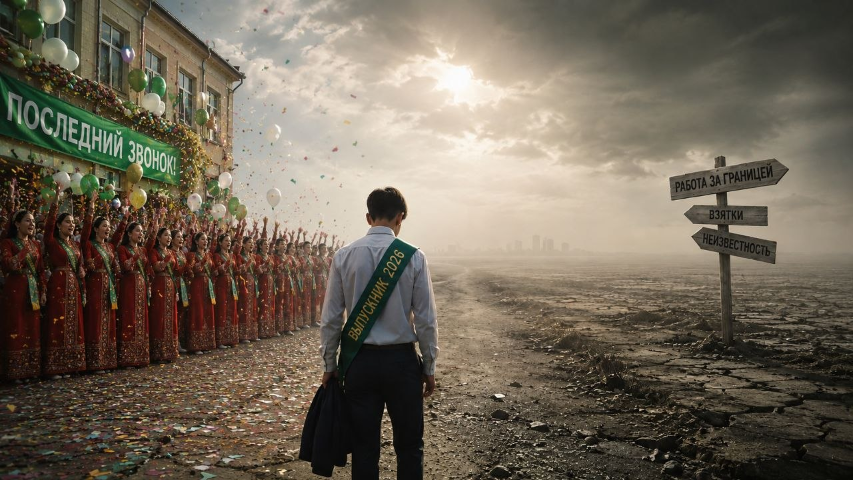
The Last Bell in Turkmenistan: A Celebration Hiding Anxiety and Uncertainty Today, the Last Bell ceremony is being celebrated across Turkmenistan. White ribbons, neatly pressed suits, flowers, farewell photographs, smiling teachers and graduates — for a few hours, everything looks festive and hopeful, as if a bright new life is beginning. But behind the carefully staged celebrations, a painful question remains: Do these graduates truly have a future in their own country? Many of today’s students already understand the reality they are about to face. A reality where success is increasingly determined not by knowledge, talent, or personal growth, but by fear, connections, money, and a system in which bribery has become normalized. From an early age, young people in Turkmenistan are raised not in an atmosphere of free self-expression, but in a system of control. Schools are gradually ceasing to be places where individuality and independent thinking can develop. Instead of encouraging personality and creativity, students experience: — identical clothing and strict conformity; — pressure and constant restrictions; — a cult of personality instead of critical thinking; — fear of making even minor mistakes; — inspections of books and notebooks; — behavioral control; — humiliation and interference in personal boundaries. Particularly alarming are reports about the practice of virginity testing of schoolgirls — an issue that has caused shock and concern among international observers and human rights organizations. Such practices have nothing to do with education, morality, or respect for human dignity. What kind of generation is being shaped under conditions of total control and suppression of individuality? What awaits these graduates after school? Admission to universities often requires bribes. Employment frequently depends on bribes or personal connections. Even educated professionals are forced to survive on extremely low salaries. As a result, people become trapped in a system where corruption is not only visible everywhere, but where participation in it becomes a condition for survival. This creates a devastating cycle: young people grow up witnessing corruption, and later many are pressured into participating in it simply to live. However, many never even reach that stage. Thousands of young citizens of Turkmenistan leave the country in search of work, education, safety, and a basic sense of human dignity. Some go to Türkiye, Belarus, Russia, Europe, and other countries. People are leaving not only their homeland — they are leaving behind hope for a future. This raises another painful question: Why should young people return? To live in fear? To remain silent? To survive on poverty wages? To be denied the right to independent thought? To worship authority instead of building their own future? Can a government truly expect patriotism from young people while systematically depriving them of freedom, dignity, and opportunity? Can society expect young families to build their future and raise children under conditions of uncertainty, fear, and hopelessness? Today, demographic decline, mass migration, and the growing loss of trust among young people are becoming some of the most serious challenges facing Turkmenistan. And perhaps the most painful reality is that parents understand this even more clearly than the graduates themselves. While students may still try to enjoy the celebration, the music, and the final school memories, parents are thinking about something entirely different: — how to secure their child’s future; — where to find money; — how to protect them from unemployment and despair; — how not to lose them to migration; — how to prevent the system from destroying their lives. The Last Bell ceremony lasts only a few hours. After that, real life begins. A life filled with uncertainty. A life overshadowed by fear. A life offering too few opportunities. If the state truly wants to preserve its future, it must do more than organize symbolic celebrations. It must create conditions in which young people can: — study freely; — express themselves openly; — work without bribery; — live with dignity; — speak without fear; — build families and see their future in their own country. Because no country can have a future without a free, educated, and hopeful generation.
As a foundation, every individual's fundamental
protect and develop their rights
we are working for.