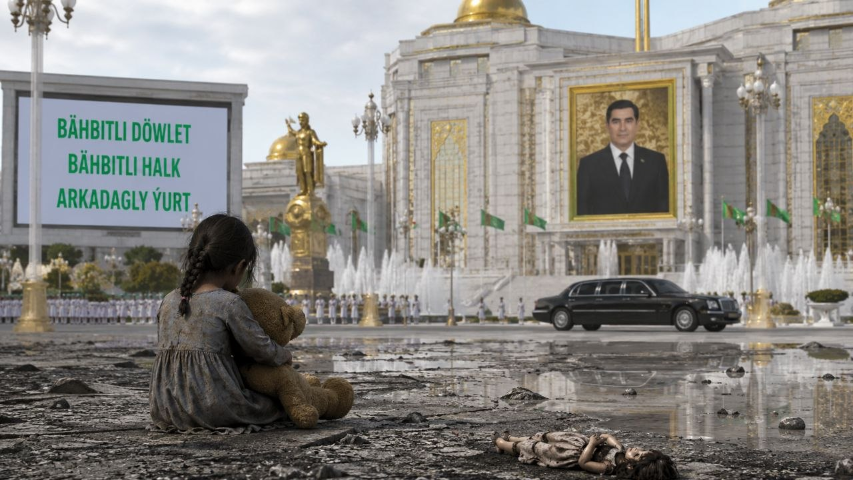
Theater of Grandeur Amid Crisis: Why the Cult of Personality No Longer Hides Reality It appears that Turkmenistan has finally entered an era where all problems have supposedly been solved. The economy is “thriving.” There is “no unemployment.” Young people are “happy.” Labor migration is probably just another invention of foreign enemies. Human rights are respected so perfectly that people are afraid to speak about them openly. And against the backdrop of all these “achievements,” the Council of Elders decided to focus on a truly historic issue: what to name an orphaned girl from an orphanage in the Ahal region. After lengthy discussions, a “historic” decision was reached — to name the child almost after Gurbanguly Berdimuhamedov himself. Just one letter difference, and another symbol of the cult of personality is born. However, an uncomfortable question immediately arises. If, as officials repeatedly claim, “there should be no orphans in the country,” then why do they exist at all? Why are thousands of children still growing up without proper support? Why does the state invest its energy into symbolic gestures instead of creating a real system of assistance? Giving a child a grand name is easy. Changing that child’s life is something entirely different. As children were abandoned to difficult circumstances before, many continue to be abandoned today. There are absolutely no crisis centers in the country for women and children affected by violence. There is no полноценной support system for girls who find themselves in difficult life situations. There is no sexual education. There is no freedom of speech. There is no independent judicial system. Human rights institutions are under pressure or are effectively unable to function independently. The healthcare system is exhausted, and many citizens are forced to seek medical treatment abroad. The media and bloggers have been transformed not into instruments for informing society, discussing real problems, and defending the interests of citizens, but into platforms for endless praise of the authorities, ceremonial spectacles, awards, and the promotion of a cult of personality. People continue leaving the country out of hopelessness. Thousands of families are separated by migration. Young people increasingly see their future not inside the country, but beyond its borders. Yet instead of discussing the demographic crisis, the collapsing economy, mass migration, corruption, the healthcare crisis, and the absence of an independent judiciary, society is once again offered another political performance. Why? Because influence is gradually fading. Fear no longer works as effectively as it once did. People increasingly see the gap between reality and televised decorations. Civil society, although slowly and cautiously, is beginning to awaken. And so the need emerges to once again demonstrate “greatness.” Not through reforms. Not through improving people’s lives. But through symbolism, ceremonies, and endless glorification of power. Meanwhile, the elders themselves have long been placed in a position where they effectively cannot openly speak about the country’s real problems. No one raises issues of poverty, the healthcare crisis, the lack of independent courts, the destruction of social institutions, or the mass exodus of the population. Instead, the state apparatus sinks deeper and deeper into political theater. There is also a growing public perception that initiatives like these are designed to create yet another wave of devotion to the cult of personality — as though people are now expected to rush to registry offices to name their children after “Arkadag.” But reality is far more complicated. People may remain silent publicly out of fear. But silence does not mean genuine admiration. When propaganda becomes excessively obsessive, it no longer inspires respect — it begins to provoke sarcasm, exhaustion, and irritation. Because real problems cannot be hidden forever behind ceremonies and staged television performances. People see everything: — labor migration; — fear and censorship; — poverty; — the lack of a future for young people; — the collapse of healthcare; — the absence of an independent judiciary; — the destruction of social institutions; — the absence of support for victims of violence; — and the way state structures increasingly focus on symbols instead of solving human problems. And the more the authorities attempt to transform the cult of personality into a national ideology, the more society begins to view what is happening not as respect, but as political absurdity.
As a foundation, every individual's fundamental
protect and develop their rights
we are working for.