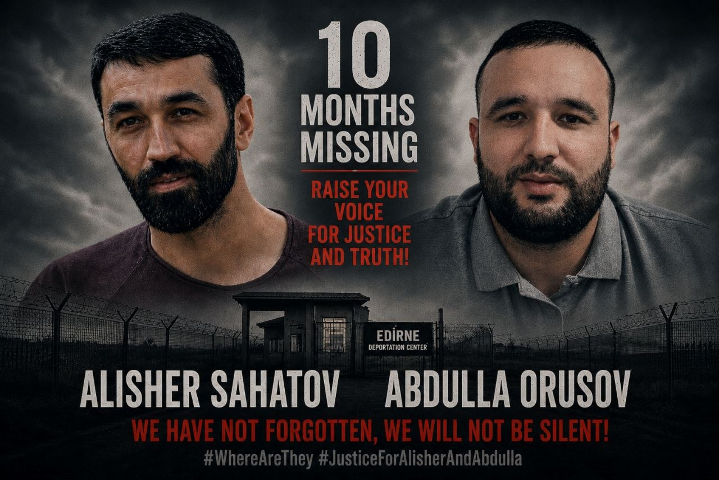
Ten Months of Pain, Silence, and Impunity The Disappearance of Alisher Sakhatov and Abdulla Orusov Remains a Symbol of Ongoing Transnational Repression Today marks exactly ten months since the disappearance of Turkmen civil activists and bloggers Alisher Sakhatov and Abdulla Orusov. Exactly ten months ago, after leaving the deportation center in the city of Edirne, Türkiye, they disappeared without a trace. Since then, there has been no official information, no transparent investigation, no answers for their families, and no accountability for those responsible. For some people, ten months is just a number. Ordinary days no different from any other. But for the family of Alisher Sakhatov, especially his wife Gülyaly Hasanowa and their four children, for friends, colleagues, and everyone who continues fighting for the truth, these ten months have become an endless psychological torment. These were ten months of: — tears; — despair; — sleepless nights; — hundreds of official complaints; — thousands of letters; — dozens of protests and solidarity actions; — documentary films; — appeals to international organizations; — desperate searches for any information; — hope for at least one honest answer. Everything has been counted in tens, hundreds, and thousands. Except for results. The result remains the same: silence. There are still no surveillance camera recordings. There is still no transparent investigation. There is still no complete information about the fate of the disappeared activists. There is still no accountability. There are still no perpetrators held responsible. The absence of surveillance footage raises even more serious questions and suspicions about who may be involved in this transnational crime and why such crucial evidence continues to be hidden from the public. But during these ten months, the families have faced not only the pain of uncertainty. They have also faced another form of violence — moral destruction. When a wife searches for her husband. When children wait for their father. When friends search for a friend. When colleagues demand the truth. In return, they receive: — cyberbullying; — insults; — humiliation; — pressure; — intimidation; — attempts to discredit them. Simply because they refused to remain silent. Simply because they continue searching for the truth. These ten months became a period in which attempts were made not only to erase the activists themselves, but also the memory of them. Attempts were made to destroy the truth, hide the traces, spread fear, and morally break those who continue speaking out. Because those who became the voice of the people, the voice of justice, dignity, and truth are dangerous to a system built on fear. At times, it felt as if there was no strength left. At times, complete despair took over. At times, there was a feeling that nobody would help and that justice no longer existed. But then comes the realization: if we remain silent today, these crimes will continue tomorrow. Without investigation. Without punishment. Without consequences. That is why transnational repression continues. That is why new tragedies continue to emerge. As in the case of Maral Annaeva. When instead of protecting a person, their life is destroyed. When international mechanisms fail to respond in time. When families are left alone with fear, uncertainty, and helplessness. Today, more and more people understand: these are not isolated tragedies. This has become a system. A system of pressure. A system of intimidation. A system of silencing critical voices. A system of transnational persecution targeting Turkmen citizens beyond the borders of their own country. Because a government that has lost the trust of its own people no longer maintains power through respect, law, or justice. It maintains power through fear. Fear of speaking. Fear of criticism. Fear of demanding rights. Fear of being abducted, deported, or disappeared. When a state begins to fear its own citizens, it stops fighting the country’s real problems and instead begins fighting those who speak about them. That is why activists, journalists, bloggers, and human rights defenders are persecuted. Because without pressure, threats, repression, and the destruction of dissent, such a system cannot maintain itself. Because it is impossible to endlessly hide: — crisis; — corruption; — mass migration; — poverty; — fear; — the absence of freedom of speech; — the destruction of human lives. That is why those who speak about these realities must be silenced. But silence will not restore justice. Silence will not stop these crimes. Silence will not return disappeared people to their children and families. Today, the story of Alisher Sakhatov and Abdulla Orusov has become not only the tragedy of two families. It has become a symbol of the entire system of transnational repression against citizens of Turkmenistan. And until an independent international investigation is conducted, until the public receives answers, and until those responsible are identified and held accountable, this story will not end. No one is forgotten. Nothing is forgotten. We continue to demand: — an independent international investigation; — the release of all information and surveillance footage; — the establishment of the fate of Alisher Sakhatov and Abdulla Orusov; — accountability for all those responsible; — an end to transnational repression; — urgent humanitarian protection mechanisms for activists and human rights defenders; — an immediate international response to ongoing disappearances, deportations, and persecution of Turkmen citizens. Freedom of speech is not a crime. Demanding justice is not a crime. The disappearance of people is a crime.
As a foundation, every individual's fundamental
protect and develop their rights
we are working for.