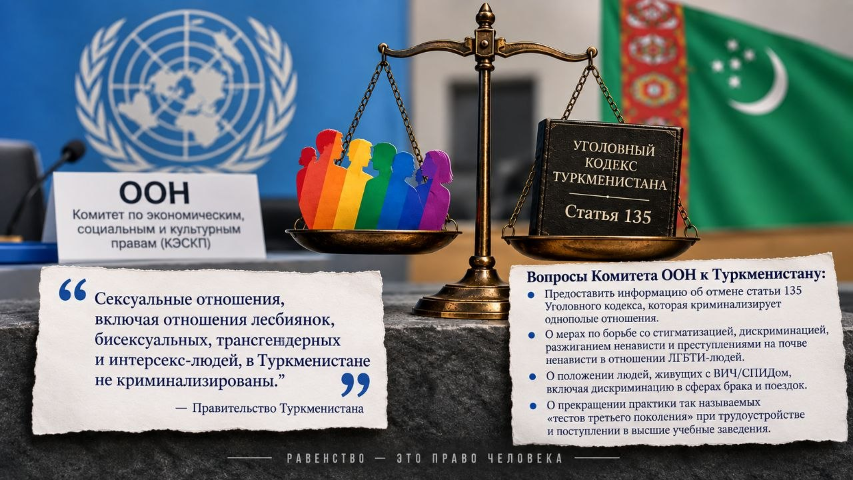
“Not Criminalized.” There Is Just an Article in the Criminal Code: Turkmenistan’s Arithmetic of Human Rights The Government of Turkmenistan has submitted a response to the UN Committee on Economic, Social and Cultural Rights that deserves particular attention. According to the published information, the authorities state that sexual relations involving lesbians, bisexual, transgender and intersex persons are not criminalized in Turkmenistan. That sounds almost encouraging. There is just one small legal detail: in the very same dialogue, the UN Committee asks Turkmenistan about repealing Article 135 of the Criminal Code, which criminalizes same-sex relations. This produces a rather unusual formula: “It is not criminalized here. Now, let us discuss the article of the Criminal Code that criminalizes it.” Perhaps this is a special form of legal logic available exclusively in official reports. But the issue is far more serious than sarcasm. The UN Committee has also requested information on measures taken to combat stigmatization, discrimination, incitement to hatred, and hate crimes against lesbian, gay, bisexual, transgender and intersex people. It also raises the situation of people living with HIV/AIDS, including restrictions and discrimination related to marriage and travel, as well as the practice of so-called “third-generation tests” in employment and admission to higher education. What is needed here is not polished language prepared for an international committee, but concrete answers: Which legal provisions have been repealed? What safeguards have been introduced? How many cases of discrimination have been investigated? What effective mechanisms of protection actually exist? Human rights are not measured by how well a state drafts its responses to the United Nations. They are measured by whether a person can live without fear of criminal prosecution, humiliation, discrimination, or state interference in their private life. And when a criminal provision exists at the same time as the authorities claim that there is no criminalization, one obvious question arises: Perhaps the next step will be to explain that the article exists, but considering it to exist is simply an incorrect interpretation of the law?
As a foundation, every individual's fundamental
protect and develop their rights
we are working for.