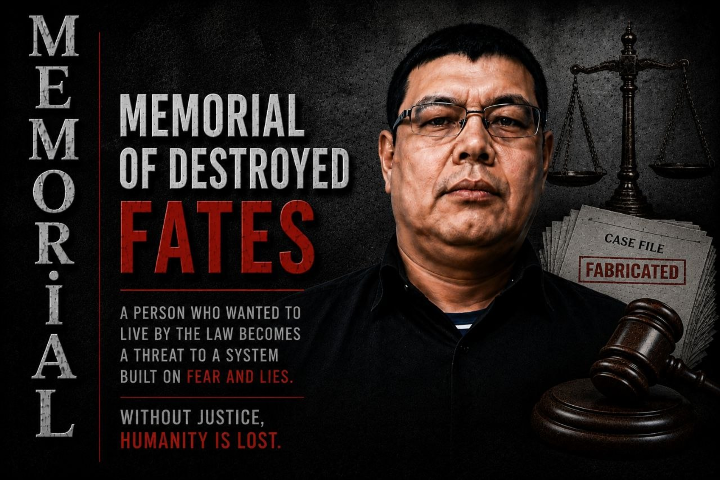
Memorial of Destroyed Lives Murat Dushemov — A Man Punished for Believing in the Law The story of Murat Dushemov is the story of a man who believed that the law in his country should apply equally to everyone. Not according to orders. Not according to fear. Not according to instructions from above. But according to the law and the Constitution. It was precisely because of this belief that his life was effectively destroyed. Murat Dushemov was not an armed radical, did not call for violence, and did not attempt to destabilize the country. On the contrary, he was one of the few people who openly spoke about legal awareness, respect for the Constitution, and the lawful rights of citizens. He asked questions that are considered normal in any society governed by the rule of law: Why do officials and police officers often refuse to show documents? Why are citizens afraid to ask for legal justification? Why does the Constitution exist only formally? Why do people not know their own rights? Murat believed that the main problem in society was fear and legal illiteracy, which the system could easily exploit. This is why he became interested in civic activity, studied legislation, and discussed the possibility of creating a civic platform and a political party. The most disturbing part of this story is that, according to Murat and his relatives, officers of the Ministry of National Security initially created the impression that legal reforms and lawful civic participation were actually possible in Turkmenistan. They spoke with him. They suggested that the country needed “new people.” An atmosphere was created in which it appeared that the authorities might tolerate moderate civic activity carried out within the framework of the law. Murat believed them. He consulted with the Ministry of Adalat, studied the procedures for registering a political party, discussed legal mechanisms, and sincerely tried to act lawfully. In reality, he was doing exactly what the authorities of Turkmenistan constantly speak about at international forums: “rule of law,” “development of civil society,” and “respect for the Constitution.” But very quickly it became clear that all of this had been a trap. The moment Murat began treating his constitutional rights not as symbolic declarations but as real rights of a citizen, he became a threat to the system. Because for an authoritarian system, the most dangerous people are not armed individuals, but citizens who: know the law; demand that it be respected; are not afraid to ask questions; want to live according to the Constitution rather than fear. Such people undermine the foundation of a system built on silence and obedience. After this, the pressure began. In 2021, Murat was forcibly placed in an infectious disease hospital under the pretext that he allegedly had tuberculosis. He was held together with genuinely ill patients, given unknown medications, and effectively subjected to medicine being used as a tool of intimidation and pressure. Later, administrative and criminal cases began to be fabricated against him. One of the most widely known incidents involved a video recorded at a clinic where Murat asked a medical employee questions regarding vaccination and possible contraindications for his mother. He did not threaten anyone. He did not shout. He did not attack anyone. He simply asked questions and demanded explanations. But already the next day, a complaint was filed against him. After that, events escalated rapidly: fines; detentions; surveillance; pressure on relatives; threats; interrogations; arrests of friends and acquaintances. Particularly revealing was the moment when Murat and his friend refused to comply with unlawful police demands and asked officers to provide the legal grounds for their actions. For the system, this itself became a challenge. Because a citizen who demands that authorities obey the law automatically becomes a dangerous example for others. After his detention, criminal proceedings were initiated against him. Later, individuals were reportedly placed in Murat’s cell, and after a conflict occurred, Murat himself was accused of causing bodily harm. Human rights defenders and relatives consider this case fabricated. The trial was accompanied by numerous violations: relatives were deliberately misinformed; the proceedings lacked transparency; no independent investigation was conducted; the family was unable to obtain justice. As a result, Murat Dushemov was sentenced to four years of imprisonment. But even prison did not break him. While imprisoned, Murat continued speaking about human rights violations, fabricated cases, and the situation of political prisoners. Together with other prisoners, he attempted to pass information to representatives of the United Nations regarding: pressure inside the prison system; violations of prisoners’ rights; restrictions on family visits; denial of communication with relatives; abuses committed by prison authorities. It was after this that the pressure intensified even further. When the term of his original sentence was nearing completion, many hoped Murat would finally be released. Instead, a new criminal case was opened against him. According to available information, the new accusations again involved alleged bodily harm and violence inside the prison colony. Human rights defenders consider these accusations to be another fabrication. In practice, a man already under complete control of the prison system was simply given an additional eight years of imprisonment. These additional eight years became a symbol of how political prisoners in Turkmenistan can be kept imprisoned almost indefinitely through new accusations, closed proceedings, and the absence of independent investigations. The story of Murat Dushemov reveals a terrifying reality: in Turkmenistan, the dangerous people are not criminals, but citizens who want to live according to the law and demand respect for the Constitution. This is not a memorial to a dead man. This is a memorial to a destroyed life. To the life of a man who believed in the law — and was punished precisely because of that belief. Today, the name of Murat Dushemov has become a symbol of political persecution, the destruction of freedom of speech, and the fear authorities have of citizens who are capable of thinking independently, asking questions, and knowing their rights. Freedom of speech is not a crime. Demanding respect for the law is not extremism. A civic position is not a threat to the state. Freedom for Murat Dushemov
As a foundation, every individual's fundamental
protect and develop their rights
we are working for.