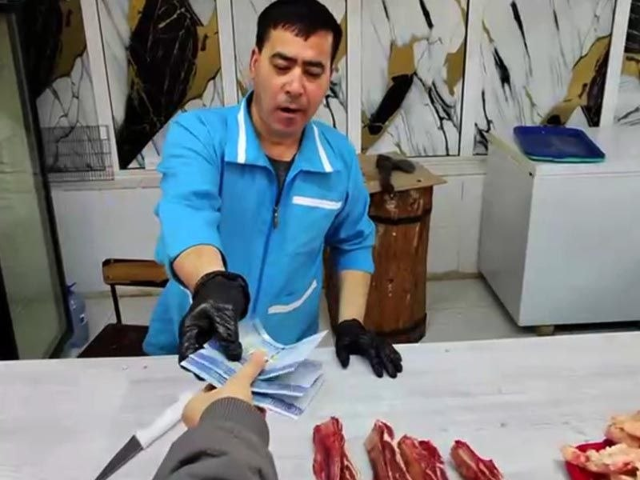
Meat Is Becoming Unaffordable: Prices Rise in Turkmenistan as Local Official Is Accused of Extorting Traders Food prices continue to rise in Turkmenistan, and one of the most painful increases for the population is the growing cost of meat. Against the backdrop of low salaries, pensions, and social benefits, more and more citizens say that beef is becoming a product many families can no longer afford to buy regularly. On 14 September, turkmen.news reported on the situation in Koytendag district of Lebap region. According to a source cited by the outlet, district governor Rustam Allaberdyev ordered meat shops to close after sellers raised the price of beef from 140 to 145 manats per kilogram. The traders reportedly explained that the price increase was not an attempt to make additional profit, but rather the result of higher wholesale prices and a shortage of livestock. However, according to turkmen.news, the governor rejected their arguments and demanded that they restore the previous price, warning that otherwise the shops would remain closed. As a result, residents of the district were effectively left without access to meat for several days. The subsequent developments raise even more serious concerns. According to information obtained by turkmen.news, after the shops were closed, traders were allegedly told through intermediaries that they would have to pay in order to resume operations. The report states that the sellers initially offered 1,000 manats each, but were allegedly asked to pay twice that amount. After the money was handed over, the meat shops were allowed to reopen. Yet the price of meat did not fall. According to the outlet, it instead rose to 150 manats per kilogram. This means that the administrative intervention failed to solve the main problem — the affordability of food for the population. On the contrary, if the allegations reported by the source are accurate, the case illustrates how arbitrary price controls and alleged corruption can further worsen the situation for both entrepreneurs and consumers. Citizens Complain: Meat Already Costs 200–240 Manats Comments posted by citizens on social media suggest that the officially cited prices do not always reflect the real cost of meat across different parts of the country. Some users report significantly higher prices. One person said that boneless beef costs 205 manats per kilogram, another cited a price of 230 manats, while another wrote that boneless meat is being sold for as much as 240 manats per kilogram. Other citizens draw attention to the dramatic gap between food prices and the level of pensions and other social payments. One woman provided a simple calculation: with a monthly pension of around 350 manats, even one kilogram of meat costing 180 manats would consume more than half of the entire monthly payment. After purchasing basic food, a pensioner would have almost nothing left for utilities, medicines, vegetables, or other essential expenses. Another user asked a direct question: “How can anyone survive for an entire month on a pension of 350 manats?” These comments point to a much broader problem. For low-income families, pensioners, and people who rely entirely on state benefits, buying meat on a regular basis is becoming virtually impossible. Families are being forced either to drastically reduce their consumption or give up meat altogether. Why Are Prices Rising? Turkmen.news links the increase in fresh meat prices to a decline in livestock numbers, including animal deaths, as well as rising feed costs. Administrative pressure forcing traders to sell meat below their purchase price cannot resolve the underlying causes of the shortage. If wholesale costs continue to rise while sellers are prohibited from adjusting retail prices, the likely consequences are shop closures, disappearing supplies, and further growth of the informal market. The situation is especially alarming if economic restrictions are accompanied by demands for unofficial payments from public officials. According to turkmen.news, Rustam Allaberdyev was appointed governor of Koytendag district in February 2026. The outlet also claims, citing a local source, that a similar scheme had previously been used against building-material traders: their work was restricted, and they were allegedly allowed to resume operations only after paying a substantial bribe. The Problem Goes Far Beyond the Price of Meat The situation in Koytendag points to a systemic problem: citizens are caught between rising market prices, low incomes, and arbitrary administrative decisions. The problem cannot be solved simply by ordering traders “not to raise prices” while the cost of animal feed continues to increase, livestock numbers decline, and wholesale prices rise. The underlying economic causes of shortages must be addressed, fair competition must be ensured, allegations of corruption by public officials must be independently investigated, and household incomes must be brought closer to the real cost of living. When a pensioner receives only a few hundred manats per month while one kilogram of meat may cost 200–240 manats, this is no longer merely a question of one product becoming more expensive. It is a question of people’s access to adequate nutrition and a decent standard of living. Source: turkmen.news, 14 September 2026 https://turkmen.news/2026/09/14/v-turkmenistane-hakim-zakryl-myasnye-lavki-iz-za-povysheniya-tsen-na-govyadinu-zatem-za-vzyatku-snova-razreshil-otkryt/
As a foundation, every individual's fundamental
protect and develop their rights
we are working for.