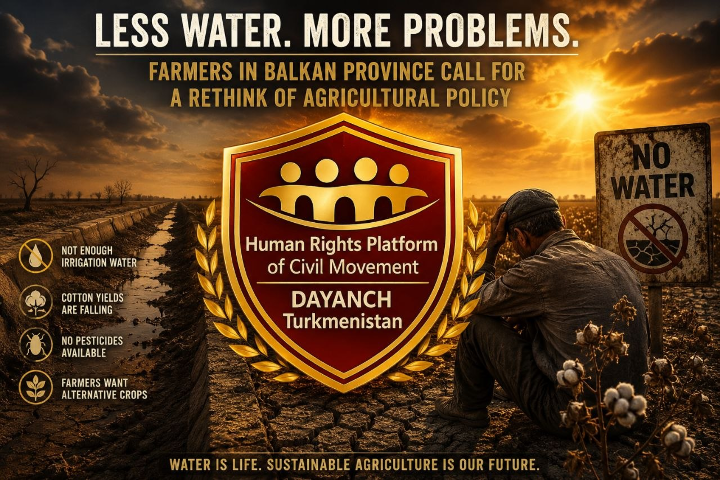
Less Water, More Problems: Farmers in Balkan Province Call for a Rethink of Agricultural Policy Agriculture in Turkmenistan's Balkan Province is facing a serious challenge. Against the backdrop of extreme heat, chronic water shortages, and continued changes in regional leadership, local farmers are increasingly saying that the country's current agricultural policy no longer reflects the realities on the ground. According to Azatlyk Radiosy, farmers are urging the authorities to abandon mandatory cotton cultivation and allow a transition to less water-intensive crops. According to residents of Bereket District, temperatures have reached 46°C during the peak of the summer season, while irrigation water has become critically scarce. Many cotton fields are no longer receiving sufficient water. As a result, the plants have stopped developing properly, begun flowering prematurely, and are unlikely to produce a full harvest. The situation has been further aggravated by an infestation of agricultural pests. Farmers report that state agricultural services have run out of pesticides needed to protect the crops. Instead, local authorities have reportedly advised farmers to purchase the necessary chemicals at their own expense, despite the significant financial losses many are already experiencing. These developments come amid yet another round of personnel changes in the region. Following the dismissal of the previous governor of Balkan Province, a new governor has been appointed. However, local residents say that replacing officials does not address the underlying structural problems. Water shortages, deteriorating irrigation infrastructure, and the absence of a long-term agricultural strategy continue to undermine farming across the region. Farmers are increasingly calling for a reassessment of the state's agricultural policy. In their view, cultivating cotton under conditions of worsening water scarcity is becoming both economically and environmentally unsustainable. Instead, they advocate expanding the production of vegetables, melons, and livestock farming, which require significantly less water and have the potential to generate higher incomes. One local farmer argues that the state earns only limited revenue from cotton production, whereas growing vegetables, tomatoes, melons, watermelons, and other agricultural products could provide substantially greater economic returns while reducing pressure on the country's already limited water resources. The situation in Balkan Province once again raises broader questions about the future of agriculture in Turkmenistan. The country is already considered one of the states most vulnerable to the impacts of climate change and increasing water scarcity. Nevertheless, government agricultural policy continues to prioritize cotton production—one of the most water-intensive sectors of agriculture. At the same time, state media continue to report successful agricultural development and high harvest yields. However, reports from independent sources and testimony from farmers present a starkly different picture: water shortages, deteriorating agricultural infrastructure, rising production costs, and a lack of effective solutions to long-standing problems. The situation unfolding in Balkan Province demonstrates that climate change is already having a direct impact on the lives and livelihoods of people in Turkmenistan. Under these circumstances, it is becoming increasingly important not only to modernize water management systems but also to fundamentally reconsider the country's agricultural development model in light of today's climatic and economic realities. --- This article was prepared based on a report by Azatlyk Radiosy published on 14 July 2026. Original source: https://www.azathabar.com/a/balkanly-dayhanlar-suw-yok-pagtacylygy-bes-edip-bakja-ekinlerine-gecmeli-diyyarler/33803375.html
As a foundation, every individual's fundamental
protect and develop their rights
we are working for.