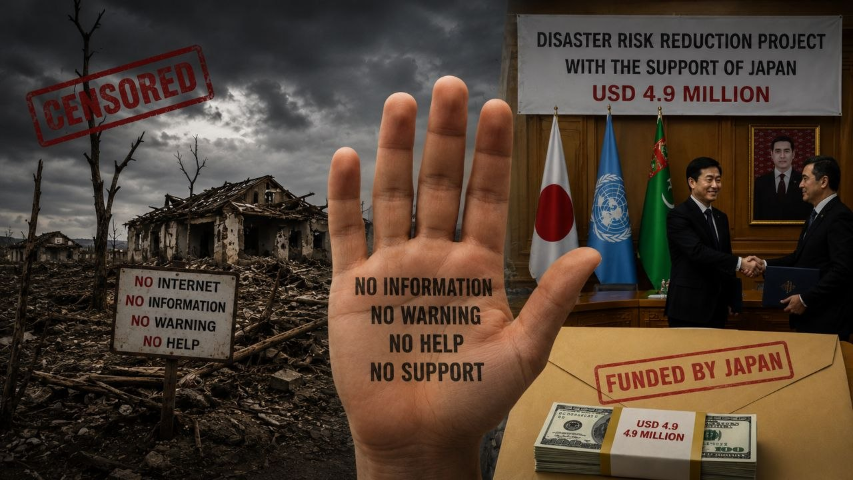
Japanese Funding and the Right to Information: Can People Be Protected While the Truth Is Being Hidden? According to information published by Chronicles of Turkmenistan, citing the United Nations Development Programme (UNDP), the national component of the regional project "Strengthening the Regional Disaster Risk Reduction System in Central Asia" has officially been launched in Turkmenistan. The project is being implemented by UNDP in cooperation with the Main Directorate of Civil Defense and Rescue Operations of the Ministry of Defense of Turkmenistan, with financial support from the Government of Japan. Japan has allocated approximately USD 4.9 million for the initiative. The project will run until 2028 and aims to strengthen early warning systems, improve disaster preparedness, enhance cooperation among government institutions, and raise public awareness of disaster risks. At first glance, such an initiative deserves support. Any effort aimed at protecting human lives and reducing the impact of natural disasters is of great importance. However, one fundamental question remains. Can an effective disaster protection system be built in a country where the government systematically conceals information from its own people? For many years, the authorities of Turkmenistan have followed the opposite approach. During natural disasters, the government does not inform the public about the true scale of events, conceals the consequences of disasters, and restricts access to information. In some cases, internet access has reportedly been disrupted during emergencies, making it impossible for people to obtain or share timely information about what is happening. When citizens publish photographs or videos documenting destruction and the consequences of natural disasters, they reportedly face pressure to delete the materials and stop disseminating information. Instead of transparency and public awareness, society is confronted with censorship and intimidation. At the same time, the population does not receive timely warnings about impending disasters. People are not informed about how to respond to earthquakes, storms, floods, or other emergencies, where to evacuate, where to seek shelter, or how to protect themselves and their families. Particularly alarming is the situation of those affected after disasters occur. Citizens who lose their homes, property, or livelihoods do not receive government assistance, compensation, or support. They are effectively left to cope with the consequences on their own, while information about the scale of destruction and the number of victims remains inaccessible to the public. This is why official statements about establishing modern early warning systems appear deeply contradictory. It is impossible to speak of disaster preparedness where the government conceals information about imminent dangers, restricts access to information, pressures eyewitnesses, fails to educate the public about emergency safety measures, and provides no government assistance or support to those affected by disasters. The right to life is not limited to advanced technologies or modern equipment. It also includes the right to be informed about dangers, the right to receive timely warnings, the right to assistance, the right to accurate information, and the right to report events freely without fear of intimidation or retaliation. Without respect for these fundamental rights, even the most advanced international projects risk becoming little more than impressive reports that fail to improve the lives of ordinary people. The Dayanç Human Rights Platform calls on the Government of Japan, UNDP, international organizations, democratic governments, international financial institutions, donors, and investors to consider not only the technical aspects of such projects but also the actual human rights situation in Turkmenistan. We call on the international community to refrain from expanding cooperation and investing in government projects in Turkmenistan until the authorities demonstrate genuine respect for fundamental human rights, particularly: the right to access accurate and reliable information; the right of citizens to receive timely warnings about threats; the right to the protection of life and health; the right to government assistance during emergencies; the right of independent journalists and civil society to report freely without censorship or persecution. True public safety does not begin with new early warning technologies. It begins with transparency, government accountability, and respect for human rights. As long as the authorities continue to conceal the truth from their own people, international disaster preparedness projects will inevitably stand in stark contrast to the reality faced by millions of citizens of Turkmenistan.
As a foundation, every individual's fundamental
protect and develop their rights
we are working for.