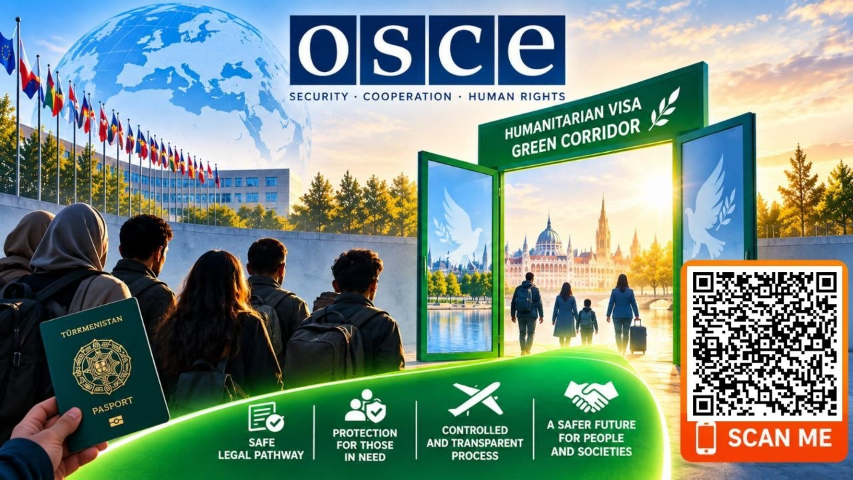
GREEN CORRIDOR FOR CITIZENS OF TURKMENISTAN: A HUMANITARIAN VISA AS A SAFE AND TRANSPARENT PROTECTION MECHANISM Thousands of citizens of Turkmenistan are currently living outside their country. Among them are civil society activists, human rights defenders, independent journalists, and others who, because of their civic engagement, public position, or persecution, find themselves in extremely vulnerable circumstances. The situation is particularly serious for those who no longer have access to valid Turkmenistan identity or travel documents and, at the same time, have no effective access to international protection mechanisms in their current country of residence. For people who fear persecution because of their civic, human rights, or journalistic activities, returning to Turkmenistan may pose a serious risk to their liberty, safety, and physical integrity. This problem therefore cannot be regarded solely as a migration or passport issue. In certain cases, it is fundamentally a matter of protecting individuals from possible persecution, arbitrary detention, ill-treatment, and other serious human rights violations. The Human Rights Platform of the Dayanç Civil Movement proposes that the international community consider establishing a special humanitarian mechanism that we call the “Green Corridor.” What is the “Green Corridor”? The “Green Corridor” would provide citizens of Turkmenistan who are outside the country and have well-founded fears of persecution with an opportunity to apply to the competent authorities of a democratic state for a humanitarian visa or another form of lawful authorization to enter the country for the purpose of seeking international protection. This proposal does not call for the automatic issuance of visas to everyone who applies. It calls for the creation of a controlled procedure under which, before an applicant enters its territory, a state would be able to verify the person’s identity and documents, examine the circumstances of the case, review the applicant’s history of civic or professional activities and the grounds for seeking protection, and carry out the necessary security checks. Each case should be assessed individually. In this way, the receiving state would know in advance whom it is admitting to its territory, why that person is seeking humanitarian protection, and what circumstances form the basis of the application. Why Are Existing Mechanisms Insufficient? Many citizens of Turkmenistan find themselves trapped in a legal and humanitarian dead end. To seek international protection in a safe country, a person must somehow reach that country’s territory or obtain lawful authorization to enter it. But how can a civil society activist, human rights defender, or journalist do so when they are in a third country, have no valid passport, cannot safely return to Turkmenistan, and at the same time have no effective access to a protection mechanism in their current country of residence? Some citizens of Turkmenistan, including those residing in Türkiye and countries of the Commonwealth of Independent States (CIS), face precisely this type of situation. Access to mechanisms involving the United Nations High Commissioner for Refugees (UNHCR) is also not the same in every country. Depending on the country of residence, registration, refugee status determination, and the examination of protection claims may be handled by national authorities, while UNHCR’s role and operational capacity may vary considerably. Therefore, the mere fact that a person is outside Turkmenistan does not necessarily mean that they have practical access to a safe and effective pathway to international protection. For civil society activists and other persons fearing persecution, the situation is further complicated by the risk of transnational repression. Individuals may fear disclosure of their whereabouts, pressure on relatives, cooperation between authorities in the country of residence and Turkmen state institutions, detention, or forced return. As a result, a vicious circle emerges: A person cannot safely return to Turkmenistan. They cannot obtain or replace the necessary travel documents. They may have no effective access to international protection mechanisms in their current country of residence. Access to UNHCR mechanisms is not equally available in every country. They cannot lawfully travel to another safe country because they lack the necessary passport or visa. At the same time, they remain at risk of detention, loss of legal status, or forced return. The purpose of the “Green Corridor” is to break this legal and humanitarian deadlock. The Passport Problem Is One of the Key Factors Particular attention must be paid to the passport situation faced by citizens of Turkmenistan who live or temporarily reside abroad. Article 29(3) of the Law of Turkmenistan on Migration provides for the processing and issuance of passports to citizens of Turkmenistan through Turkmenistan’s diplomatic missions and consular offices abroad. In practice, however, citizens outside the country report being unable to obtain a new passport, replace an expired document, or otherwise resolve their passport situation through Turkmenistan’s diplomatic missions. For any person, the absence of a valid passport creates serious restrictions. For a civil society activist, human rights defender, or journalist, the consequences can be considerably more dangerous. Telling such a person to “return to Turkmenistan and obtain a passport there” cannot be regarded as an acceptable solution when that person claims a well-founded risk of persecution by the authorities of their country of origin. This creates a paradoxical situation: national legislation provides a mechanism for issuing passports to citizens abroad, yet in practice a person may remain without the very document necessary for lawful travel and for seeking safety. When Almost Every Lawful Path Is Closed For some citizens of Turkmenistan, several doors may therefore close simultaneously. They cannot safely return home. They cannot obtain a valid passport abroad. They may have no accessible and effective mechanism for seeking international protection in their country of residence. Access to UNHCR is not equally available as a practical protection mechanism in every country. They cannot travel to a safe country without a passport and visa. And taking an irregular route exposes them to further dangers. What is a person supposed to do in such circumstances? This is precisely where the “Green Corridor” becomes necessary. A humanitarian visa would allow the case to be considered before a dangerous journey, before an irregular border crossing, and before another migration crisis occurs. A Matter of Security for Both Sides The “Green Corridor” would serve the interests not only of applicants but also of receiving states. It would enable a state, in advance, to: verify the applicant’s identity; examine the documents provided; review the person’s history of civic, journalistic, or human rights activities; assess individual risks; carry out the necessary security screening; establish the grounds for the humanitarian application; and make an informed individual decision before the person enters the country. The “Green Corridor” is therefore neither uncontrolled migration nor a demand to open borders. It represents the opposite approach: prior screening and lawful admission instead of uncertainty. An Alternative to Irregular Routes The absence of a lawful pathway does not eliminate a person’s need for safety. If an individual fears persecution but cannot obtain a passport, has no accessible protection mechanism in the country where they are currently staying, and cannot legally reach a safe country, this creates conditions in which people may become dependent on smugglers or other intermediaries, vulnerable to exploitation, forced into undeclared employment, or driven toward dangerous irregular migration routes. The “Green Corridor” could significantly reduce these risks. Applicants would know where they are applying, what documents they must provide, which authority is considering their application, on what grounds a decision will be made, and how they may lawfully travel to the receiving country if their application is approved. The receiving state, in turn, would know in advance whom it is admitting. A lawful humanitarian pathway is safer and more transparent than uncontrolled movement between countries. The “Green Corridor” Is Not Automatic Immigration The proposed mechanism does not mean the automatic granting of asylum, citizenship, or permanent residence. It means providing a lawful humanitarian pathway. States would retain the authority to establish criteria for examining applications, conduct identity and security checks, request evidence supporting the circumstances of an individual case, and make an individual decision on each application. Human rights organizations could provide available documentation, record the circumstances of individual cases, and assist with the verification of relevant information. Following lawful arrival, the question of international protection would be examined by the competent authorities of the receiving state in accordance with its national legislation and applicable international obligations. A humanitarian visa would therefore not replace the asylum system. It would create a safe pathway to a protection procedure for people who currently may have no realistic way of accessing one. Transparency Instead of Uncertainty We propose a model in which the state knows whom it is receiving, while the individual knows where they are going and on what legal basis. The state receives information in advance and has an opportunity to conduct the necessary checks. The applicant receives a lawful pathway instead of uncertainty and an irregular route. Society receives a transparent procedure instead of uncontrolled migration. Human rights organizations gain an opportunity to document and support genuinely vulnerable cases. For these reasons, the “Green Corridor” can simultaneously serve human rights protection, security, the rule of law, and transparency. Our Appeal to the International Community We call upon democratic states, the European Union, international organizations, and human rights institutions to consider establishing a special humanitarian visa mechanism for citizens of Turkmenistan who are currently in third countries and have no safe and lawful pathway to international protection. Particular attention should be given to civil society activists, human rights defenders, journalists, and other individuals who may face persecution because of their civic activities or public positions. We are not proposing that borders be opened without controls. We are proposing: screening instead of uncertainty; a lawful route instead of an irregular one; a humanitarian visa instead of a dangerous journey; prior assessment instead of a crisis at the border; protection of the individual while safeguarding the security of the receiving state. We call this mechanism the “Green Corridor.” For the receiving state, it provides an opportunity to know in advance and verify the person to whom humanitarian entry is being granted. For a citizen of Turkmenistan, it provides an alternative to having to choose between living without valid documents, taking a dangerous irregular route, or returning to a country where they fear persecution. For the international community, it offers an opportunity to transform the principle of human rights protection into a concrete and workable mechanism. A safe pathway should exist before a person reaches the border. We call upon the international community to support the “Green Corridor” initiative and to begin practical discussions on establishing a humanitarian visa mechanism for citizens of Turkmenistan in need of international protection.
As a foundation, every individual's fundamental
protect and develop their rights
we are working for.