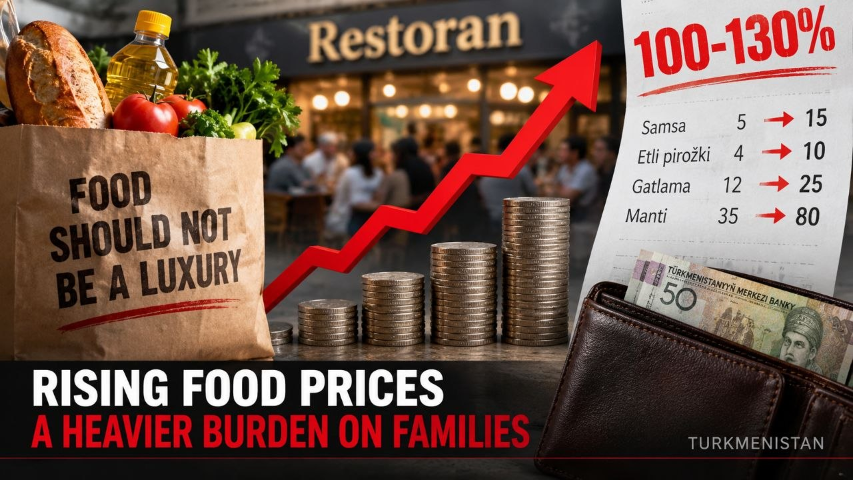
Food Is Becoming a Luxury: Rising Prices in Turkmenistan Hit Ordinary Families Hardest As Turkmenistan prepares for the upcoming session of the Halk Maslahaty, reports continue to emerge from inside the country about sharp increases in the cost of food and prepared meals. According to Radio Azatlyk on 3 September 2026, prices for some dishes in restaurants and cafés have risen by 100–130%, while restaurant workers report a decline in the number of customers. In Balkanabat, according to Azatlyk’s sources, samsa that previously cost around 5 manats is now being sold for 12–15 manats, a meat pastry has increased from 4 to 10 manats, and gatlama from 12 to 25 manats. A portion of manty that previously cost around 35 manats may now cost as much as 80 manats. Prices for meat dishes have also risen significantly. Behind Restaurant Prices Lies a Deeper Problem The increase cannot be viewed solely as a problem affecting restaurants. Restaurant owners and employees attribute rising prices primarily to the sharp increase in the cost of meat, labour, taxes and utilities. At the same time, the agricultural sector is also facing serious difficulties. Livestock farmers report high costs for animal feed, veterinary services and medicines. As a result, meat production is becoming increasingly unprofitable, while these additional costs are ultimately passed on to consumers. This creates a vicious cycle: it is becoming too expensive for farmers to produce, too expensive for businesses to sell, and too expensive for ordinary citizens to buy. Inflation Cannot Be Hidden Behind Official Figures The rise in prices is particularly severe against the backdrop of low household incomes and the continuing dual exchange-rate system. Even if official indicators suggest economic stability, the real purchasing power of citizens is determined not by government reports, but by how much food a family can actually afford with its salary or pension. When the cost of ordinary food doubles while people’s incomes fail to increase accordingly, this is no longer simply a matter of individual products becoming more expensive. It becomes an issue of people’s access to adequate food and a decent standard of living. The Human Rights Platform of the Civil Movement “Dayanch” / Turkmenistan believes that economic and social issues must be discussed openly at the upcoming Halk Maslahaty and must reflect the actual living conditions of citizens. The state must publicly answer: Why, despite the country’s vast natural resources, is ordinary food becoming increasingly unaffordable for the population? Why are citizens, farmers and small businesses being left to bear the consequences of rising prices, inflation and economic imbalances on their own? A country’s economic well-being is not measured by official statements or ceremonial events. Above all, it is measured by whether an ordinary family can buy food, feed its children and maintain a decent standard of living without fearing what tomorrow will bring. Source: Radio Azatlyk, 3 September 2026.
As a foundation, every individual's fundamental
protect and develop their rights
we are working for.