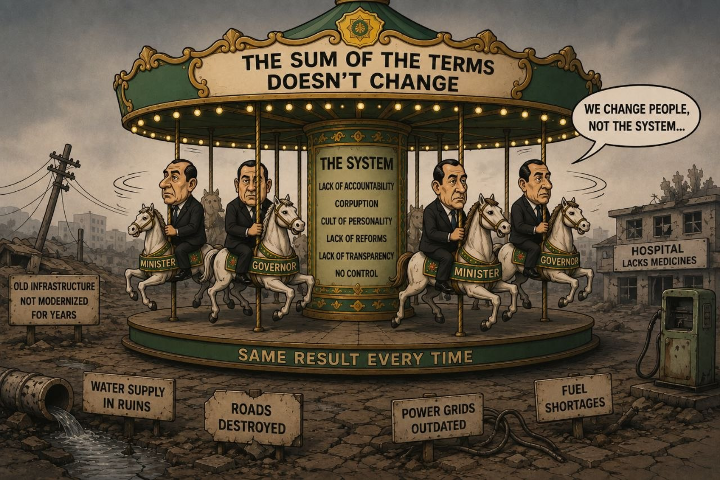
Changing the Players Doesn't Change the Game: Governors Come and Go, but the System Remains Turkmenistan has once again witnessed what has become a familiar political ritual: another round of high-level personnel reshuffles. At an expanded meeting of the Cabinet of Ministers, President Serdar Berdimuhamedov announced the dismissal of several ministers, regional governors (hyakims), and other senior officials. The official wording has also become routine: "serious shortcomings in work," "transfer to another position," or "appointed with a probationary period." The names on office doors change. But does the system itself change? Judging by the results, the answer is no. Every year, state media proudly report "stable economic growth," record GDP figures, and the country's continued success. Yet almost simultaneously, new dismissals of senior officials are announced. If everything is developing so successfully, why is there a constant need to replace ministers and governors? If the economy is truly growing steadily, why do citizens continue to face fuel shortages, power outages, problems in agriculture, and other chronic difficulties? The answer is obvious. The problem has never been limited to a particular minister or a particular governor. The problem lies within the system itself. Once again, the authorities seek to create the impression that replacing one official with another will automatically solve the country's problems. It resembles trying to repair an old car by constantly changing drivers without ever opening the hood. Officials can be moved from one office to another indefinitely. Warnings can be issued. Probationary periods can be imposed. People can be dismissed, reappointed, and dismissed again. But if the system itself remains unchanged, the outcome will remain exactly the same. The Mary Region offers a particularly revealing example. For years, it has struggled with corruption in the agricultural sector, causing significant losses for both farmers and the state, as well as recurring power outages, fuel shortages, and other long-standing problems. However, it would be a mistake to attribute all of these issues solely to one governor. Many of these challenges stem from systemic corruption, the absence of effective oversight, and the fact that infrastructure across many regions of Turkmenistan has not been modernized for decades. Aging power grids, deteriorating public utilities, poor roads, outdated water supply systems, and other neglected infrastructure are problems not only in Mary Region but throughout much of the country. Replacing one official cannot reverse the consequences of decades without meaningful structural reforms. This raises an obvious question: If a new governor is appointed tomorrow, will corruption disappear? Will the power grid suddenly become modern? Will fuel reappear at filling stations? Will roads, water systems, and public utilities repair themselves overnight? Of course not. Because the problem is not an individual's name or position. The problem is a governing system that continues to reproduce the same failures year after year, relying on personnel reshuffles instead of genuine reform. Turkmenistan has developed a familiar political tradition. When problems become too visible, officials are replaced. When the problems remain, more officials are replaced. When the crises continue, another round of reshuffles follows. It has become a political conveyor belt. Yet the result is always the same. You can rearrange the pieces on a chessboard as many times as you like. But if the rules of the game never change, neither will the outcome. Instead of meaningful reforms, society receives new appointments. Instead of transparency, it hears another list of "shortcomings in work." Instead of systemic accountability, responsibility is shifted onto individual officials. Real change, however, does not begin with replacing the name on an office door. It begins with government accountability to its citizens, an independent judiciary, a free press, genuine anti-corruption efforts, transparent decision-making, and respect for human rights. Until these foundations exist, personnel reshuffles will remain little more than an attempt to create the illusion of change. Here, the well-known mathematical principle is especially fitting: Changing the order of the addends does not change the sum. Turkmenistan can continue replacing ministers, governors, and senior officials indefinitely. But until the system itself changes, the lives of ordinary people will not.
As a foundation, every individual's fundamental
protect and develop their rights
we are working for.