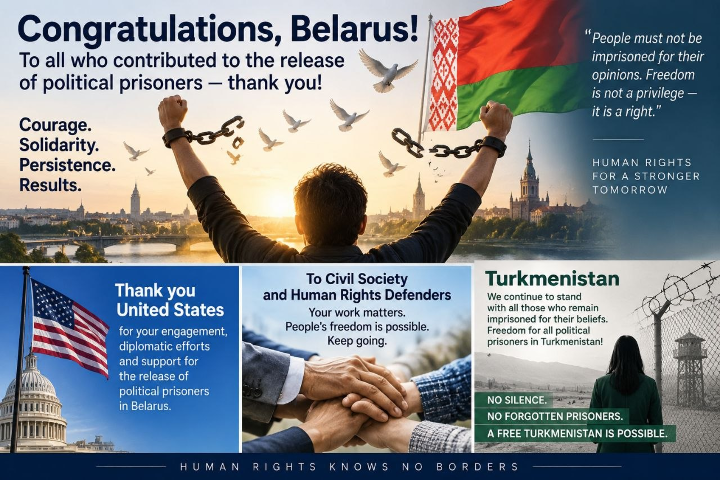
Belarus Releases Political Prisoners Again. Why Has Turkmenistan Failed to Achieve Comparable Results for Decades? On 16 September 2026, following another round of talks with U.S. presidential envoy John Coale, 25 more political prisoners were released in Belarus. Importantly, this was not an isolated case. It was another stage in a series of releases, and the total number of prisoners freed in recent rounds is now measured in the hundreds. Prominent journalist Andrzej Poczobut was among those released during an earlier round. He subsequently returned to Belarus for the first time since his release and was then able to leave the country for Poland without obstruction. The latest round was also accompanied by concrete steps in relations between Minsk and Washington. According to the BBC, the United States announced the lifting of sanctions on two Belarusian enterprises, while Coale said that the U.S. authorities had approached Citibank with a request to unfreeze $44 million in Belarusian funds. This does not mean that repression in Belarus has ended, nor does it in itself demonstrate a systemic improvement in the country's human rights situation. Nevertheless, there is one crucial practical result: people are being released from prison. And this raises an extremely uncomfortable question for Turkmen civil society: Why, after more than twenty years of international activity by Turkmen human rights defenders and opposition groups, have we failed to achieve comparable results? Years of statements. Dozens of conferences. Protests. International forums. Appeals to the United Nations, the OSCE, the European Union and democratic governments. Interviews, reports and social media campaigns. But where is the result that can be shown to the family of a political prisoner with the words: here is a person whose release was achieved through sustained and systematic international advocacy? This question must be addressed not only to the authorities of Turkmenistan and the international community. It must also be addressed to ourselves — Turkmen human rights defenders, civil activists and opposition organisations. Why is Turkmen civil society abroad so fragmented? Why is so much energy spent on internal conflicts, mutual accusations and disputes over who is a “real” human rights defender or opposition figure, who has greater achievements, and who has the right to represent Turkmenistan? Why does it sometimes appear that demonstrating one's own importance and superiority has become more important than achieving concrete results? The Belarusian experience is particularly important because the human rights issue there has reached the level of direct international negotiations, where the fate of specific prisoners becomes part of the discussion. This is no longer merely a statement or a photograph taken after an international conference. The result can be measured by the number of people who actually walk out of prison. This is precisely the kind of measure of effectiveness that we often lack. Not how many conferences we attended. Not how many photographs we took outside the UN, OSCE or European Parliament. Not how many strong statements we published. Not how many years we have called ourselves human rights defenders or opposition leaders. But what, concretely, has changed for people? Who has been released? Who has received international protection? Which family has been reunited? Who has regained the ability to travel freely? In which specific case did we secure effective international intervention? Which demands of civil society were ultimately implemented? Of course, it would be unfair to attribute the absence of such results solely to shortcomings among Turkmen activists. Turkmenistan remains an extremely closed state. Independent journalism inside the country is virtually impossible, civic organisation is severely restricted, obtaining reliable information about detainees and prisoners is extremely difficult, and pressure may extend to the relatives of people living abroad. Belarus and Turkmenistan are different countries, and their situations cannot simply be equated. But the very difficulty of the Turkmen situation should, after more than twenty years, have led to the creation of an even more professional and coordinated system of international advocacy. Instead of competition between organisations, there should be coordination. Instead of struggles over status, there should be a division of responsibilities. Instead of one-off high-profile statements, there should be sustained, long-term work on individual cases. Instead of endlessly listing our own achievements, there should be measurable results. The main question should therefore not be: “Who among us is the leading human rights defender?” Nor should it be: “Who represents Turkmenistan?” The question is much simpler: “What has actually changed in people's lives because of our work?” When prison doors in Belarus open once again and dozens of people are released, while the overall number of those freed in recent processes is already measured in the hundreds, Turkmen civil society should not merely watch from the sidelines. We should study the mechanism: How does the name of a particular prisoner reach the negotiating table? Who consistently works on that person's case? Who maintains diplomatic pressure? How is an international coalition built around the case? And what ultimately creates the conditions in which the authorities agree to a release? Because after more than twenty years of activity, what we need is not another argument about who has done more. We need an answer to a far more important question: Where are our concrete results and clear examples demonstrating that human rights work has genuinely changed a person's fate? And if there are too few such examples, perhaps the time has come not to defend old methods, but to seriously reconsider the strategy itself.
As a foundation, every individual's fundamental
protect and develop their rights
we are working for.