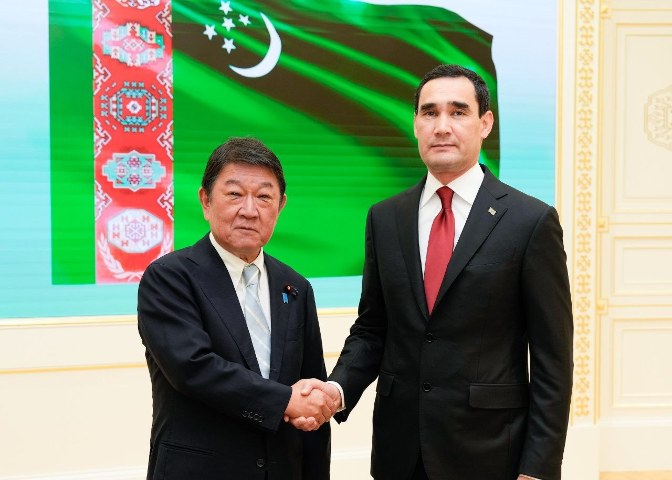
A “Reliable Partner” with a Dual Exchange Rate: What Lies Behind Turkmenistan’s Official Economic Narrative Two reports published almost simultaneously clearly illustrate the gap between Turkmenistan’s official image and the economic reality faced by its citizens. On 30 August, President Serdar Berdimuhamedov received Japan’s Minister for Foreign Affairs, Toshimitsu Motegi. According to the official report, the Japanese side views Turkmenistan as a “reliable partner,” while relations between the two countries are described as a long-term strategic partnership. The parties discussed cooperation in the gas and chemical industries involving Japanese companies Itochu Corporation, Toyo Engineering Corporation and Kawasaki Heavy Industries. However, the report makes no mention of one of the principal obstacles to transparent business activity and foreign investment: the long-standing existence of two entirely different exchange rates in Turkmenistan. Read more about the meeting. The official exchange rate remains fixed at 3.50 manats to the US dollar, while citizens have virtually no opportunity to purchase foreign currency freely from state-owned banks. On the unofficial market in early September, new US dollar banknotes were reportedly bought for approximately 18 manats and sold for 18.20–18.30 manats. In Turkmenabat, the selling rate reached 18.60 manats. Even after the reported “sharp decline,” the dollar still costs more than five times the official rate. Data from Chronicles of Turkmenistan. This raises an obvious question: how reliable can a country be considered by foreign partners when its official exchange rate exists largely on paper, free currency conversion is unavailable, and actual financial transactions are forced to rely on the illegal market? Public reactions are particularly revealing. One reader suggested that the temporary decline in the dollar exchange rate was linked to the authorities’ need to obtain manats ahead of the Halk Maslahaty meeting and predicted that the situation would return to its previous state by the end of September. Another citizen drew attention to extremely low wages, the large-scale exodus of the working-age population and the real depreciation of the manat. Another participant in the discussion called on the authorities to disclose publicly the country’s financial obligations to foreign companies and international financial institutions. This prompted the bitter response: “Who said that the government intends to repay its debts?” The comment receiving the strongest support from readers suggested that certain influential individuals urgently needed a large amount of manats and therefore began selling foreign currency. There is no evidence confirming this version. Nevertheless, its popularity reveals something important: the profound lack of public confidence in the government’s currency policy. A decline in the dollar exchange rate from 19–19.50 to approximately 18 manats does not indicate an economic recovery. As long as the official rate of 3.50 manats remains inaccessible to ordinary citizens, the gap between figures presented in government reports and the actual value of foreign currency will remain more than fivefold. The true reliability of a state is determined not by diplomatic compliments or costly industrial projects, but by economic transparency, the free convertibility of its currency, credible statistics and the ability of citizens to use and manage their earnings freely. Turkmenistan may be a profitable partner for foreign companies. For its own citizens, however, the state’s “reliability” continues to be measured by queues, restrictions, low incomes and the dollar exchange rate on the black market.
As a foundation, every individual's fundamental
protect and develop their rights
we are working for.