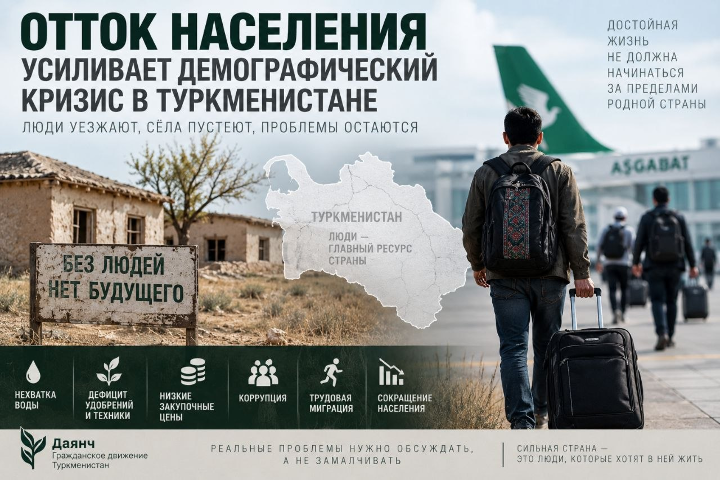
A Queue for the Future: Why More Citizens of Turkmenistan Are Seeking Education and Work Abroad Large queues have formed outside the Consulate of Kazakhstan in Turkmenbashi. According to Radio Azatlyk, those applying include citizens who want to study or work in Kazakhstan, as well as ethnic Kazakhs considering relocation. Sources cited by the outlet say that the number of such applicants has increased noticeably compared with August last year. At first glance, this may appear to be merely a queue outside a foreign consulate. But behind this image lies a much more serious question: why do more and more people see their future outside Turkmenistan? Studying Abroad Is Becoming a Necessity Rather Than a Choice According to Azatlyk’s sources, young people’s growing interest in Kazakhstan is linked, among other factors, to difficulties in accessing higher education in Turkmenistan. One young person claimed that admission to a domestic university is virtually impossible without unofficial payments and that the amounts demanded can reach $15,000. Other sources reported alleged unofficial payments ranging from $12,000 to $20,000. In addition, according to Azatlyk’s sources in the Balkan and Lebap regions, the number of applicants taking university entrance examinations in Turkmenistan this year fell by 50–70% compared with previous years. If these reports are accurate, this is no longer simply a question of corruption. It is a question of young people’s equal right to education and to determine their own future. A family that does not have tens of thousands of dollars should not be forced to choose between paying, giving up on higher education, or sending their child abroad. Labour Migration Reflects Problems at Home The queues for Kazakh visas cannot be viewed separately from the broader migration situation. There have previously been numerous reports of Turkmen citizens travelling to Türkiye and other countries in search of employment. Kazakhstan is now becoming another increasingly visible destination for education, labour migration and possible permanent relocation. The reasons are recurring: unemployment, low incomes, corruption, limited educational opportunities and a lack of confidence in the future. When young people increasingly seek education abroad, working-age citizens leave to earn a living, and families begin to view emigration as a way to build a normal life, the state should not obstruct their departure. It should ask why they are leaving. Exit Restrictions Cannot Solve the Problem It is particularly concerning that, against the backdrop of growing migration, reports continue to emerge of citizens being prevented from boarding international flights or otherwise being restricted from leaving the country. Administrative restrictions cannot stop migration. You cannot prohibit people from searching for a future when the state fails to provide them with one at home. The more the authorities attempt to conceal or administratively contain the consequences of socio-economic problems, the wider the gap becomes between the official image of prosperity and the reality experienced by ordinary citizens. Where Are the Official Statistics? Another serious problem is the lack of transparent and publicly accessible data on the scale of labour and educational migration. How many citizens leave Turkmenistan each year for employment? How many young people enrol in foreign universities? How many citizens leave for permanent residence abroad? How is the size of the economically active population changing? Without open statistics, it is impossible to objectively assess the scale of what is happening. The authorities of Turkmenistan should not deny the country’s migration and socio-economic problems. They should acknowledge them and begin addressing the underlying causes that compel citizens to leave: unemployment, low incomes, corruption, unequal access to education and the lack of genuine opportunities for young people. A queue outside a foreign consulate is not simply a queue for a visa. It is a queue of people searching beyond their own country for education, work and a future they have been unable to find at home.
As a foundation, every individual's fundamental
protect and develop their rights
we are working for.