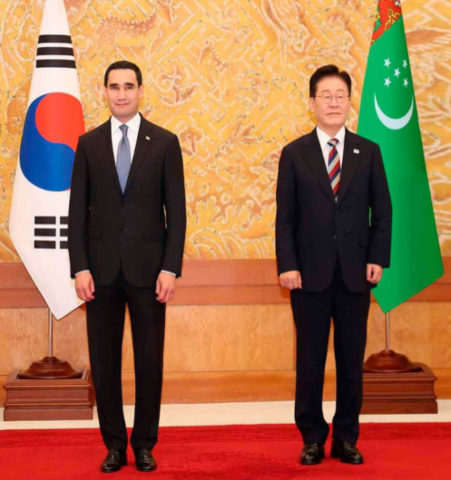
Another Episode from the “Quasi-World”: An Honorary Doctorate in Political Science When I wrote my short article “Quasi-World,” I described a world in which form increasingly replaces substance, grand titles replace genuine achievements, and ceremonial events replace answers to uncomfortable questions. And now we have yet another illustration of exactly what I meant. On 15 September 2026, President of Turkmenistan Serdar Berdimuhamedov was awarded the title of Honorary Doctor of Political Science by Sungkyunkwan University in the Republic of Korea. According to reports about the ceremony, the distinction was attributed, among other things, to his “extensive experience in foreign policy,” his role in Turkmenistan’s state development, and his contribution to political stability and economic development in Central Asia. And here one very simple question arises: for what specific achievements in political science? Not in diplomatic protocol. Not in interstate relations. Not simply for making a presidential visit. I mean specifically in the field whose name now appears alongside the word “Doctor.” Of course, this is an honorary doctorate, not an academic degree earned through the conventional process of years of research, writing a dissertation, and defending it. But that is precisely why it is important to understand which specific accomplishments the university decided to recognize symbolically with such a title. The irony of the situation is almost perfect. One of the world’s most technologically advanced countries welcomes the leader of Turkmenistan — and instead of an uncomfortable conversation about the quality of governance, institutional transparency, freedom of information, human rights, and the actual state of political institutions, we see an academic gown and a ceremonial title. An astonishing display of twenty-first-century political science efficiency: apparently, years of research can sometimes be replaced by a state visit and a ceremony. One cannot help wondering how researchers must feel at such a moment — those who spend years collecting data, publishing their work, undergoing peer review, debating within the academic community, and devoting a significant part of their lives to studying political institutions. Perhaps no one ever told them that there was a shorter academic route. But behind the sarcasm lies a serious question. An honorary title is a symbol. And when that symbol comes from a university, it carries reputational weight. The public therefore has every right to ask: what exactly does the university consider worthy of such recognition, and what verifiable criteria were used in making that decision? Here it is — my “Quasi-World” in miniature: the title exists, the ceremony exists, the beautiful words exist — yet between the name of the distinction and the question of concrete achievements, there is an enormous void. And the louder the fanfare, the more visible that void becomes. My previous article, “Quasi-World”: https://x.com/Kaska261694/status/2020544545747013996
As a foundation, every individual's fundamental
protect and develop their rights
we are working for.