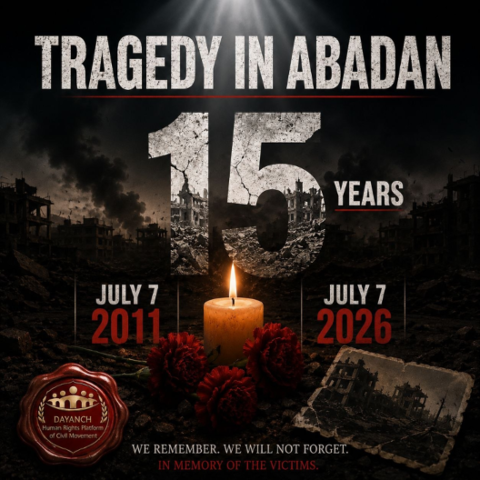
15 Years Since the Abadan Tragedy: A Truth That Cannot Be Erased by Silence On 7 July 2026, fifteen years have passed since one of the most devastating tragedies in the modern history of Turkmenistan. On 7 July 2011, a series of massive explosions at military ammunition depots in the city of Abadan (now Büzmeýin), located just a few dozen kilometres from Ashgabat, destroyed residential neighbourhoods, reduced streets to rubble, and changed the lives of thousands of people forever. Fifteen years have passed. During this time, Turkmenistan has built new monuments, hosted international forums, and celebrated numerous official events. Yet the authorities have still failed to do the one thing that matters most: tell the truth to their own people. To this day, the Government of Turkmenistan has not conducted an independent investigation into the causes of the disaster, has not publicly established the full circumstances of what happened, has not held those responsible accountable, has not published a complete list of those killed and injured, has not erected a memorial to the victims, and has not officially recognised 7 July as a national day of remembrance. A Tragedy the Authorities Want Forgotten In the immediate aftermath of the explosions, the authorities remained silent. Later, the government claimed that exceptionally high temperatures had caused explosions at warehouses containing pyrotechnic materials and initially stated that there had been neither significant destruction nor fatalities. Only several days later did the authorities officially acknowledge the deaths of 15 people—13 military personnel and 2 civilians. However, reports by independent media outlets, international journalists, and human rights organisations presented a very different picture. According to these sources, the explosions occurred at military ammunition depots, and the scale of the destruction was far greater than officially admitted. Various independent sources have provided widely differing estimates of the death toll, ranging from several hundred to more than 1,300 people. These estimates differ substantially from the official figures and remain the subject of ongoing debate because no independent investigation has ever been conducted. Fifteen years later, the absence of a transparent investigation and the continued withholding of information mean that the full truth about the tragedy remains unknown. Silence Instead of Remembrance In countries that have experienced tragedies of this magnitude, governments usually seek to honour the victims. Memorials are built. The names of the victims are published. Days of remembrance are observed. Families receive official condolences. In Turkmenistan, the opposite has happened. The Abadan tragedy has virtually disappeared from the country's official history. State television does not mention it. No official commemorative events are held. No public statements are issued. No memorial has been erected. The names of most victims have never been made public. It is as though the tragedy never happened. But memory cannot be erased by decree. The People Still Remember In 2025, the Dayanç Human Rights Platform / Turkmenistan produced a short documentary film dedicated to the Abadan tragedy. Its purpose was simple yet profoundly important: to preserve the memory of those who lost their lives and to give a voice to those who survived that horrific day. The documentary can be viewed here: https://youtube.com/shorts/hHk5wAOM0FE?si=BssIekTHjsgCCnW1 Following its publication, dozens of people shared their memories of the tragedy. For many, it was the first time they had spoken publicly about what they had witnessed. To protect their privacy, we do not identify the authors. However, we believe that some of their testimonies deserve to be heard: > "Our cousin died there. He was a military officer. He had just graduated from university and had only recently begun his service."> "I was just a child. We ran without knowing where to go. There was no electricity for a long time. Everyone was in panic." > "We were there too. Rockets were exploding right next to us. Our houses were on fire. It was terrifying." > "My son was serving in Abadan at the time. I nearly lost my mind worrying about him." > "Eyewitnesses said that many people had died, but television reported that there had been no fatalities." > "I remember that day as if it were yesterday. I still cannot forget it." > "After the explosion, my friend's brother lost his hearing. I studied near the site of the blast." > "Women were crying on the roads. I can still hear those screams. May God never allow such a tragedy to happen again." > "How many soldiers became disabled? How many died? It was a horrific tragedy." > "The blast wave shattered windows across the city. Communications disappeared. It felt like the end of the world." These statements are not the findings of an official investigation. They are personal recollections shared by people who survived the tragedy or lost their loved ones. Nevertheless, together they reveal the profound human suffering that no official statistics can adequately convey. Why the Truth Matters Abadan is not merely a tragedy of the past. It is a question of a state's responsibility towards its own citizens. Without truth, there can be no trust. Without an investigation, there can be no lessons learned. Without acknowledgement, there can be no justice. Government silence does not erase the fact that thousands of people continue to live with the consequences of that day—the loss of loved ones, lifelong psychological trauma, and memories that will never fade. As long as official archives remain closed and society is denied access to the full truth, these questions will remain unanswered. Our Call On the fifteenth anniversary of the tragedy, the Dayanç Human Rights Platform / Turkmenistan calls on the authorities of Turkmenistan to: conduct an independent, transparent, and internationally monitored investigation into the events of 7 July 2011; publish complete information about all those who were killed, injured, or remain unaccounted for; guarantee the families of the victims their right to truth and justice; establish legal accountability for any officials found responsible for negligence or wrongdoing; create an official memorial in honour of all the victims; officially recognise 7 July as a National Day of Remembrance for the victims of the Abadan tragedy. Memory Is Stronger Than Silence Fifteen years ago, people lost their lives. For fifteen years, their families have waited for answers. For fifteen years, the state has chosen silence. But tragedies do not disappear simply because people stop talking about them. As long as eyewitnesses remain alive, as long as families preserve the memory of their loved ones, and as long as civil society continues to document testimonies and evidence, the truth will endure. Memory cannot be forbidden. Truth cannot be buried. The victims of Abadan deserve not silence, but remembrance. Not oblivion, but justice.
As a foundation, every individual's fundamental
protect and develop their rights
we are working for.